

Available to buy here:
Welcome. Today I’m looking at the Poly Voyager Free 60 (also sold in a “+ UC” variant) — a pair of true wireless earbuds with a strong emphasis on call quality, adaptive ANC, and smart features. Let’s see whether they live up to that promise.
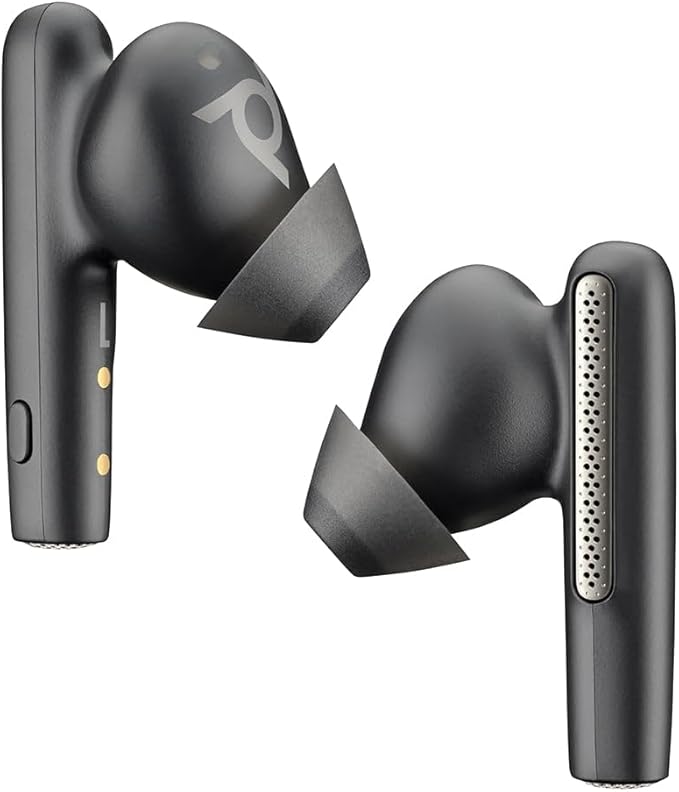
From the outset, these earbuds pitch themselves as more than just music gear. They aim to serve people who do a lot of calls — remote workers, hybrid professionals, salespeople, team leads — in environments where background noise, switching between devices, and maintenance of call clarity matter. The manufacturer highlights six microphones total (three in each bud) plus WindSmart technology to reduce wind noise; adaptive active noise canceling; transparency mode; multipoint Bluetooth; and a Qi-compatible charging case with a fast-charge option. There’s also support for controlling calls and media from either earbud, and protection against splashes/dust with an IP54 rating.
Let me walk you through my full experience — from setup to everyday use — and point out where these shine and where they struggle.
I’ll start with setup. Pulling the earbuds and case out of the box, you’re given the buds, multiple eartip sizes, the charging case, a USB-C cable, and (in the UC or “+” version) a BT700 USB-A Bluetooth adapter. You pair either via Bluetooth in the usual way, or use that adapter for better range or more stable PC connection. That adapter was already pre-paired in my test unit, so plugging it into a laptop gave instant connectivity. In day-to-day use I appreciated that multipoint support allows you to keep two active Bluetooth connections — for example, phone + laptop — without having to constantly re-pair.
Getting a good fit matters here: both for audio quality and for noise canceling effectiveness. I tried the small, medium, and large conical eartips and settled on medium in my ears. Even so, in longer sessions I noticed some mild fatigue — not severe, but these aren’t the most discreet or ultra-light buds for extended wear. That matches what some other reviewers noted — comfort was flagged as a weak point in long use. The stems are somewhat bulky, and wearing them overnight (if you’re a side sleeper) would be difficult.
Testing in real-world conditions, I ran several scenarios:
Calls in home office / open-office background noise: I placed the buds in both standard ANC and adaptive ANC modes, then made calls while the vacuum, air conditioner, and some ambient chatter were running. The caller reported I was quite audible, and they heard less of the background hum than I expected. The WindSmart tech helps when there’s light breeze or movement. But when traffic or more chaotic noise was present (e.g. near a street), some background sounds did leak through, and occasionally a clicking or artifact during transitions between noise levels was noticeable.
Music / media listening: I streamed tracks (pop, acoustic, orchestral) in ANC and transparency off modes to gauge the general audio side. The sound signature defaults to a somewhat boosted low end, which gives a satisfying thump in genres with bass, but that comes at a slight cost to midrange clarity. Voices and instruments sometimes seem subtly recessed. Switching to the “Bright” EQ preset helps, but then you lose some of the warmth. For casual listening the experience is acceptable; it won’t compete with high-end audiophile buds, but it’s competent.
Mobility / walking / commuting: I walked outdoors, toggling transparency mode and adaptive ANC. Transparency does let you hear surroundings without removing the earbud, which is handy for crossing streets or hearing announcements. The ANC was helpful in bus or train settings; it reduced low-frequency rumble (engine, HVAC) quite well — though it was less effective in aggressively noisy settings (e.g. a crowded café). The IP54 rating gives me more confidence in durability under light sweat or occasional splashes.
Battery life & charging: With adaptive ANC on, the official spec claims ~5.5 hours on earbuds + extra via the case; in my steady-music test (medium volume, 75 dB SPL) I got around 6 hours and 15–20 minutes, which is quite close to expectations. The charging case added additional recharges, getting me through a workday. The fast charge is useful — 15 minutes gives over an hour of talk time. Wireless Qi charging worked reliably with my charger pad, and I liked the convenience of placing the case rather than fumbling with wires.
Use in hybrid setups / meetings: Because of the inclusion of the touchscreen (in the “+” version) on the charging case and the app (Poly Lens), I often switched between devices mid-call. The case lets you select ANC mode, switch sources, mute, etc. The touchscreen feels a little gimmicky at times — taps sometimes need repetition, and menus reset when you close a widget — but it does bring control options to your fingertips without needing to pull out a phone. The Lens app also allows sidetone adjustment (how much of your own voice you hear), toggle auto-detection behavior, and firmware updates.
Now, strengths and weaknesses — here’s how they trade off in practice.
On the plus side: the call quality is probably the strongest selling point. The six-mic array plus WindSmart tech means your voice is more isolated than many competing buds in everyday conditions. The multipoint connectivity and included Bluetooth adapter bring versatility. Battery life and fast-charging performance were reliable and close to specs in my tests. The Qi-capable case and the extra control options (case touchscreen, app) are nice touches that elevate the experience beyond bare-bones earbuds. For many users, especially those whose priority is voice calls, these deliver real value. The adaptive ANC does a decent job reducing ambient hums, and coupled with transparency mode it gives a workable balance.
On the downside: comfort is a recurring caveat. They’ll be fine for a couple of hours, but in marathon sessions some ear fatigue sets in. The touchscreen in the case is clever but imperfect — sometimes laggy or unintuitive to navigate. The sound tuning is serviceable but not exceptional — the bass tilt is a bit strong and can muddy mids in complex mixes. In very noisy environments the ANC doesn’t completely obliterate background sound (which is true for most earbuds), and transitions can introduce artifacts. The price is high, and you might expect nonslip fit or extra accessories given the cost, but the competition demands a lot in that bracket.
Talking about value: if your use case is heavy calling — remote work, client meetings, hybrid office life — these earbuds justify investment. But if your priority is pure music fidelity, or you rarely make calls, there may be better-suited options. For context, the Jabra Elite 2 / Elite 7 models or Samsung Galaxy Buds variants offer strong ANC and sound at lower cost, though with less specialized call optimizations. The Apple AirPods Pro (2nd gen) is another benchmark: its ANC and sound tuning are formidable, though it lacks some of the call-centric controls and multipoint flexibility of the Poly. So, you’re paying a premium for the call toolbox and hybrid-device management features here — and whether those are worth it depends on your workflow.
In terms of build and longevity, these buds feel solid. The materials are robust, the case heft protects the internals, and I didn’t observe any mechanical weakness during regular handling. The brand Poly (formerly Plantronics) has a good reputation in professional headset gear, which lends confidence. The only longevity warning would be around the buttons, touchscreen, or eartip wear over long years — but nothing so far has raised red flags. The app and firmware update pathway also suggest the product has headroom for improvements post-launch.
I did not need to engage with customer support for my test unit, but I researched: user reports suggest mixed experiences. Some report prompt firmware updates via Poly Lens, while others mention delays in resolving hardware issues. Because this is a business/communications product, I’d advise buyers check warranty policies and support reputation in their region.
Putting it all together: the Poly Voyager Free 60 is a niche—but compelling—earbud. Its core strength lies in making you sound clear in calls, managing multiple devices seamlessly, and offering flexible control via the app and case. Its weaker zones lie in absolute audio purity, comfort over very long sessions, and occasional interface quirks. If your primary use is hybrid work, lots of conferencing, or switching between PC and mobile mid-day, this could be one of the few earbuds that genuinely addresses those needs.
If I had to offer a verdict: for professionals who demand excellent voice quality and workflow flexibility, the Voyager Free 60 is a strong contender and worth serious consideration. For pure audio enthusiasts or very long listening sessions, it might not be the first choice. That said, this isn’t a flawed product — it executes on its central promises well, with trade-offs that are understandable.
Thank you for watching — the link to grab it is down in the comments section. If you own these or have questions, drop a comment and I’ll get back to you. Goodbye until next time — and remember: the best reviews live inside Reviews Inside TV.
Available to buy here:


