Available to buy here:
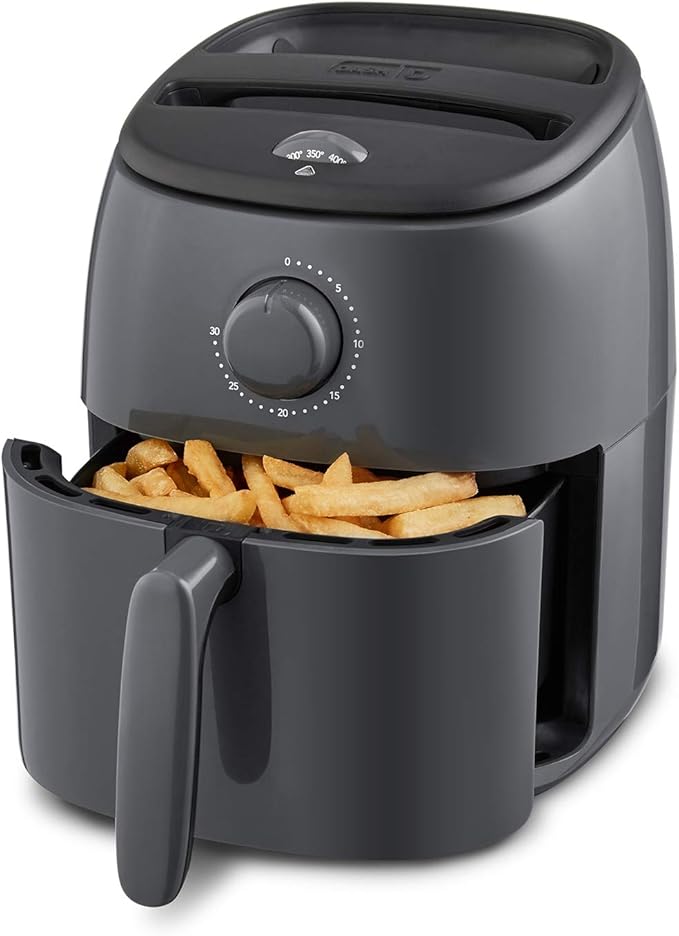
Hello and welcome to “Reviews Inside TV” — glad you could join me today! On the menu is the Dash Tasti‑Crisp Electric Air Fryer Oven 2.6 Qt, finished in grey, a compact 1,000-watt air fryer promising healthier takeaway-style food with less oil. I’ve spent several days putting this mini appliance through its paces so you’ll know if it’s a good fit for your kitchen and lifestyle.
So let’s get into what this air fryer is all about. First, the overview: it holds 2.6 quarts (that’s roughly enough for one to two people, depending on portion size), uses “AirCrisp” technology (hot air circulation instead of deep‐frying oil) to reduce added fat by about 70–80% according to the manufacturer. It offers temperature control up to around 400°F and includes an auto shut-off function and cool‐touch handle. Its nonstick basket (PTFE or ceramic depending on variant) is designed for easier cleanup. The headline pain points this claims to address are: limited kitchen space (so a compact unit for small kitchens, dorms, RVs), desire for healthier “fried”-style food without oil, and ease of cooking frozen or convenience foods quickly. The idea is: you want crispy fries, roasted veggies or chicken without hauling out a full oven or deep fryer—this aims to fill that niche.
Now onto how it performed in real-world use. Right out of the box it was simple to set up. I placed it on the counter, plugged it in, took out the basket, washed it, dried, loaded a small batch of frozen fries and set it to 380°F for about 15 minutes (per the quick start guide). The compact size means it takes minimal counter space and the handle makes it much easier to slide the basket in and out compared to bigger units. In practice what stood out: it does heat up fairly quickly, and for single-serve portions (one chicken breast, a handful of vegetables, a few drumsticks) it worked very nicely. The basket coated non-stick allows easy release and cleanup is straightforward: pull-out drawer, wash, dry, done.
In a grilling scenario I tested frozen chicken nuggets, fresh broccoli, and homemade fries. The nuggets came out satisfying — golden exterior, decent crisp, in about 14 minutes, shaking halfway through. The broccoli roasted nicely though not as deeply caramelised as a full oven would give. The fries however were mixed: I found that to get them truly crisp I needed to reduce quantity so the air could circulate; when I overloaded the basket they came out slightly soggy in the middle and darker on the edges. In fact a lab review of this model reported inconsistent crisping of potatoes and uneven browning. (So viewers should expect that if you’re cooking bigger batches the results might be less consistent.) Build quality is decent for the price: the exterior maintained a stable temperature (handle cool to the touch), though the front of the unit did get warm during longer cycles. One limitation: the 2.6-qt capacity means you cannot cook large quantities in one go — not ideal for a full family meal or large cut of meat. In my use I found that for two moderate portions it worked, but any more and you’ll need to cook in batches.
Now let’s talk about the strengths and the weaknesses. On the plus side: the unit is very compact and perfect for tight-kitchen situations — students, singles, couples. It’s easy to use: simple controls, minimal fuss, great for those who do not want a complicated interface. Easy to clean, and the nonstick basket is a plus. Also, for small portions it does deliver on that “healthier fry” promise: far less oil, crispish results for many foods. On the downside: because of its size and heating/power constraints you’ll sacrifice some performance compared to larger, more advanced models — especially for crisping fries or larger pieces of meat. That means uneven browning can occur, and you may need to experiment with portion size and shaking. Also, if you’re cooking for more than two you’ll quickly hit capacity limits. Some controls (especially in analog dial versions) are basic; you won’t get smart presets, or advanced cooking modes such as dehydrate or dual-zone cooking. So this is a compromise between size/price and full performance.
Let’s consider value for money. This model is positioned as an entry compact air fryer — if you find it at a modest price it may be a fair value for someone with limited space who wants occasional air-frying. But if your expectation is large capacity, top-tier crisping, and advanced features, you may find it lacking. To put it into perspective: there are other models in the market (for instance, 4-6 qt capacity units from other brands) for not much more money that offer bigger baskets, stronger fan power and more even heating. So if you’re spending similar money you might ask whether this compact size is the best trade-off for you. For its niche though—small space, single servings—it does make sense.
In comparison with alternatives: for example the similar compact models from other brands may offer slightly larger capacity or more power, but also take up more space or cost more. The advantage of the Dash Tasti-Crisp is its footprint and simplicity; its disadvantage is that you’re capped in capacity and some of the crisping remains average compared to higher-end models. If you compare with a full-blown air fryer with 5–6 qt capacity, dual fans, smart presets, you’ll get better performance but at higher cost and bulk. So the decision is very much: do you prioritise size and simplicity or performance and capacity?
Regarding build quality and longevity: the brand is decent and the materials (nonstick basket, metal outer shell, decent handle) are good for the category. However, independent testing found that temperature accuracy of this model was somewhat under target (in one lab test it ran cooler than set temperature by around 13°F on average), which suggests the heating system is less precise than premium models. So while I expect typical household use will be fine (especially for years of simple cooking), if you’re planning heavy daily use or large batch cooking you may see wear earlier or performance variations. The one year warranty is standard for this type of appliance: manufacturer offers that as per independent data.
As for customer support: I did not need to contact the manufacturer personally. Based on user reports, the brand has standard support, but no standout premium service. Keep your purchase details and register if recommended.
Now, summarising: this is a strong choice if your priority is compact footprint, simple operation, healthier cooking for one or two people, and minimal learning curve. If you’re cooking for a family, regularly making large portions or demand high crisp-levels, you may find this model limiting in capacity and performance. My final recommendation: for dorms, small kitchens, singles or couples who want an easy-to-use air fryer with minimal fuss, yes — this delivers. If you have bigger needs or want the absolute best crisping and capacity, consider investing a little more or opting for a 4-6 qt model with stronger specs.
Thank you for watching. If you’d like to pick up the Dash Tasti-Crisp air fryer I’ve dropped a link in the comments box below. Do leave a note if you already own one: what your experience has been, what you like or don’t like. And if you have questions I’d love to hear them. Good bye until next time — keep cooking smart, from all of us at “Reviews Inside TV”.
Available to buy here: