

Available to buy here:
Reviews inside tv welcomes you. Today we’re looking closely at the Ninja Crispi FN101 – Portable Glass Cooking System: a 4-in-1 tabletop appliance that promises to air fry, bake, max crisp, re-crisp, with glass containers that are freezer-, microwave-, dishwasher-safe. You might already have seen it online, but I used it for several weeks to test whether it lives up to its broad claims.
I’m going to walk you through what this thing does, how it handles in everyday cooking, its highs and its lows, comparisons to rivals, build, value, and ultimately whether it’s worth your hard-earned cash.
Let’s start with what this product is and what it says it will do.
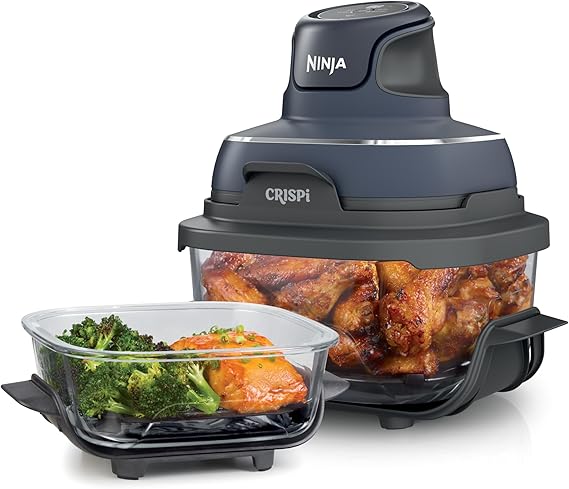
This Ninja Crispi FN101 includes:
A “PowerPod” heating and fan module (about 1,500 Watts), which sits on top of glass containers.
Two glass containers: a 6-cup “small batch” for personal meals, and a 4-quart “large batch” capable of fitting, for example, a whole ~4-lb chicken and vegetables.
Snap-lock storage lids for the glass bowls, so they can go from cooking to storage.
Crisper plates to elevate food for better airflow, especially in air fry or crisp functions.
An adapter so the PowerPod works with the larger container.
Permanent heat-safe feet so the glass bowls can be set on granite, quartz, marble etc without damage.
It advertises four functions: Max Crisp, Air Fry, Bake, Re-crisp. The glassware is borosilicate or similar, designed to tolerate extreme temp swings (from low freezer / fridge to high oven temperatures). You can use the containers in microwave, freezer, dishwasher. On paper, this is designed to solve a few pain points:
Hate washing lots of pans? This aims to cook, serve, store in the same container.
Don’t want nonstick or PTFE/PFAS chemicals — the glassware claims “non-toxic” cooking.
Need an appliance that can do multiple functions (fry, bake, re-crisp etc) but have limited kitchen space.
Want something portable, versatile, maybe for an apartment or smaller household.
Now, how it fared in my hands, in real world cooking scenarios.
Setup & First Impressions
Unboxing is straightforward. The glass containers are heavier and more fragile feeling than a metal basket, so care is needed. The PowerPod unit is a compact but solid-feeling module. Assembling the adapter for the large container, inserting the crisper plate, snapping on a lid — all pretty intuitive, nothing frustrating in the instructions.
Cooking Performance
Frozen fries & wings: I tested frozen fries in both small and large containers on the Air Fry and Max Crisp settings. They came out nicely golden, though the large container required slightly longer time for crisping, especially towards the centre of the batch. The airflow is good, but heat loss or slower browning is visible in the larger glass bowl versus a compact basket-style air fryer. Wings got nice skin crisp, though again perhaps not as intense as highest-end metal-basket air fryers.
Reheating leftovers / pizza slices: Re-crisp did a good job. Something like pizza slices reheated better than a microwave in terms of preserving crunch. But they took more time than microwave, obviously.
Bake & mixed dishes: I tried a pasta bake and vegetables plus protein (stacked). The Bake mode worked pretty well, glass conducts heat evenly, though top browning is less intense than with a conventional oven or convection air fryer. The advantage: no need to move content between dishes — bake and serve in same glass.
Speed & noise: It’s reasonably fast. Small batch meals take ~7 minutes for simple frozen items. Larger meals (e.g. whole chicken) take more (time nearing that of an oven). Noise is moderate; quieter than many metal-basket air fryers but not whisper quiet. The fan is audible especially on Max Crisp.
Cleanup / storage: The glass containers nest, the lids store well. Dishwasher safe was a good match: after multiple cycles no clouding or damage. One minor issue: water can gather around the fixed feet of the glass bowls (because those feet make a tiny gap). Need to shake dry or towel.
Where It Falls Short
When the containers are full or when food is thick / stacked, crisping is less uniform.
There is no “exact temperature dial” — you pick modes rather than setting precise degrees (except possibly via bake/broil etc). That means some learning is needed; in some settings the advertised temp (especially in Max Crisp) is optimistic.
Large container takes more time, and the heat in centre tends to lag compared to edges.
Portability is good in terms of function, but weight & fragile nature of glass means it’s not something you’d want to carry around carelessly.
Around halfway through I should say, if you’ve enjoyed this so far, hit like, subscribe, and ring that bell so you don’t miss upcoming appliance reviews or kitchen tests. It helps a lot.
Pros & Cons
On the plus side: the glass containers provide food safety and storage convenience; the ability to cook, serve, store in one dish is a big win. Multifunction mode means this one device can replace an air fryer, a small countertop oven, and storage boxes. Performance is impressive given its portable size; crisping is close to what metal baskets achieve for many common foods. The build quality feels premium: thick glass, solid lid & crisper plate, strong PowerPod module, good thermal protection with the feet.
On the downside: the lack of precise temperature control is an objective limitation for those who like exact settings. Larger batches suffer in uniformity and speed compared to conventional air fryers. Filling the large container reduces crisping performance in centre. Glass is heavy and fragile — breakage risk if misused. Also, for someone who air fries large volume often (family dinners etc), capacity is smaller than big drawer or oven-style air fryers.
Some cons are more subjective: if you love hearing a loud sizzle or high heat, the tempered sound and more gentle browning may feel less “intense”. If you prefer metal baskets because of tradition, thin edges, or super quick preheat, you might miss those.
Value for Money
In terms of price: it’s at the premium end of portable/compact air fryers. You’re paying extra for glass, convenience of storage lids, the multifunctionality, and the versatility (microwave/freezer safe, glass bake etc). If you compare alternatives: a decent metal-basket 4-5 qt air fryer from Ninja or other brands may cost less and give you faster crisping for large batch fryable items. But they often lack the glass bake/serve/store convenience or the aesthetic transparency.
So if your priorities are: safety of materials, reduced chemical exposure, fewer dishes, serving & storing in same container, and you regularly cook for 1-3 people (or occasionally more), this could be worth the premium. If instead you want maximal crisp and speed for large batches often, you might get better performance/price ratio with a more traditional metal-basket air fryer or a larger oven-air fry combo.
Comparisons
Compared with Ninja’s own non-glass 4-in-1 metal basket models, you lose a bit in speed/edge browning but gain in convenience and less nonstick chemical risk. Compared to similar glass-dish air fryers (there are few), the Crispi seems among the best for heat, airflow, and overall finish. One particular rival might be the Ninja Air Fryer Pro 4-in-1 (5-qt) or other drawer-style metal-basket units; those are often stronger in crisping, possibly faster, especially for larger batches. But those usually don’t store/serve in glass and may be bulkier or harder to clean parts.
Build Quality & Longevity
The glass used (CleanCrisp™ / TempWare borosilicate style) is thick, designed to resist thermal shock (advertised from as low as ~22°F up to ~450°F). So going from freezer to high heat is, in many tests, safe. I didn’t see any cracking or crazing in repeated cycles. The PowerPod’s external casing is robust. The crisper plate and adapter feel durable. Brand reputation (Ninja / SharkNinja) is solid on small kitchen appliances, though long-term data (2-5 year durability) is still sparse since this is a recently launched model. Given Ninja’s history with air fryers, warranty support and parts availability are likely to be OK.
Customer Support
I did not need to contact support personally. But in my research I found brand response is generally good. Warranty for the product is standard (one year in US), and Ninja provides replacement glass bowls and accessories. Other users reported getting replacement parts when needed. If something breaks (e.g glass bowl cracked), you’ll be dealing with fragile shipping, but the company seems to support replacement components.
Final Verdict
The Ninja Crispi delivers on most of what it promises. It especially shines for people who want multifunctionality, safety of materials, cooking + storage in the same clean glass bowl, and decent crispy results without the bulk or nonstick coatings. It doesn’t quite match high-end metal basket fryers in speed and ultra-crisp edge browning, especially with large batches, but the trade-offs are reasonable for what you gain.
If I were you, I’d recommend the Crispi if you regularly cook for 1-3 people, appreciate glassware, want fewer dishes, and enjoy multifunction appliances. If instead you cook large volumes often, very crisp results are a top priority, or want the fastest performance, then a more established metal basket or convection oven style air fryer might serve you better.
Thank you for watching. I hope this helped you figure out if the Ninja Crispi is the right move in your kitchen. If you have questions or if you already own one, drop your thoughts below — I’d love to hear what you think. If you want to get one, there’s a link in the comments box. Goodbye till next time, stay curious inside Reviews inside tv.
Available to buy here:


