

Available to buy here:
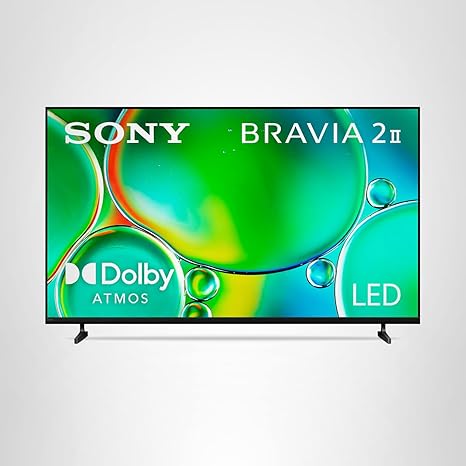
Hello and welcome to Reviews inside tv, your trusted place for honest, expert takes on the latest tech. Today, I’ve got my hands on the Sony BRAVIA 2 II 55‑inch 4K Ultra HD LED Smart TV (model K‑55S20M2, 2025) — a mouthful of a name, but a TV that aims to deliver serious value. So let’s unpack what it’s all about, how it performs, and whether it’s the right pick for you.
The Sony BRAVIA 2 II is a 55-inch television featuring a 4K (3840 × 2160) LCD panel, powered by Sony’s 4K Processor X1. It supports HDR, specifically HDR10 and HLG, and applies a clarity-enhancement engine called X‑Reality PRO to upscale content. For motion handling, it uses Motionflow XR (200 or 240 depending on region), which helps make fast-moving scenes — like sports or action movies — look smoother. On the audio side, it has two open-baffle speakers, each delivering 10 watts, and supports Dolby Audio, Dolby Atmos, and a range of DTS formats.
Connectivity is pretty generous: you get four HDMI inputs (all with Auto Low Latency Mode), two USB ports, a LAN port, and built-in Wi‑Fi (Wi‑Fi 6) plus Bluetooth 5.3. The smart features run on Google TV (via Android 12) with access to the Google Play Store, voice assistant functionality, Chromecast built-in, and Apple AirPlay 2 too. There’s also an Eco Dashboard to manage energy settings, and Sony bundles in five movie credits for the Sony Pictures Core app.
Why might someone pick this TV? Well, the BRAVIA 2 II seems designed to hit a sweet spot: a reasonably large screen, smart streaming capabilities, and a solid picture processor, without pushing into high-end OLED territory. It’s not trying to compete with the top-tier flagship TVs — it’s more about delivering dependable 4K performance, good connectivity, and a smart platform, all at a more accessible price point.
In daily use, setting up the BRAVIA 2 II was pleasantly straightforward. Out of the box, the remote, stand, and cables feel typical for a mid‑range TV — not overly premium, but well-made enough. Plugging it in and going through the Google TV setup wizard was quick. I connected Wi‑Fi, logged into my Google account, and within minutes had access to my streaming apps, like Netflix, Disney+, and YouTube.
When I tested it with movies, standard-definition content and upscaled HD looked clean. Thanks to the 4K X‑Reality PRO engine, textures felt sharpened, particularly on close-up shots — not quite native 4K clarity, of course, but very respectable for upscaled content. With HDR content, highlights popped reasonably well, though the overall brightness didn’t feel slam‑in‑your-face; it’s more modestly HDR‑capable than hyper‑bright flagship TVs. On fast sports or action scenes, Motionflow did a decent job. There was some motion clarity, but with high-speed camera pans or very rapid action, you can spot occasional softness — not unexpected given the 60 Hz (or 50 Hz in some regions) panel.
For gaming, I hooked up a PlayStation 5 via one of the HDMI inputs. Because the TV supports Auto Low Latency Mode (ALLM), the PS5 automatically switched to a low-lag mode when gaming. That’s great for responsiveness. However, keep in mind this TV doesn’t have HDMI 2.1 bandwidth or Variable Refresh Rate (VRR), so you’re limited to 4K at 60 Hz rather than true 120 Hz gaming. It still felt very serviceable for casual gaming and fast single-player titles, but it’s not aimed at ultra-competitive or next-gen performance gaming.
Audio-wise, the twin 10 W open-baffle speakers deliver sound that’s surprisingly decent for a TV of this class. Dialogues are clear, and there’s a bit of warmth. For big home cinema sound, though, you’ll likely want a soundbar or external system — the built-in audio is serviceable, not cinematic.
Smart TV performance was generally smooth. Google TV on this model feels snappy enough for daily use, with no major lag when switching between apps or scrolling through menus. The built-in Chromecast and AirPlay 2 make it easy to cast or mirror your phone or tablet. The Eco Dashboard is a useful touch for energy-conscious users; you can control standby behavior, power settings, and more from one place.
Now, as for strengths and weaknesses — the BRAVIA 2 II really nails several things, but it also has limitations.
On the plus side, it offers excellent connectivity with four HDMI ports and modern wireless support. Its 4K Processor X1 and upscaling engine are very capable, making non-4K content look good. The smart platform — Google TV — is mature and versatile, and features like AirPlay 2 and Chromecast are great for ecosystem flexibility. The Eco Dashboard is a thoughtful addition for energy management. Build-wise, the TV feels well constructed: the stand is stable, and the chassis is solid.
On the other hand, some trade‑offs are clear. The panel is limited to 60 Hz, meaning it’s not ideal for high-end gaming or ultra-smooth motion for serious gamers. There’s no local dimming, which means contrast isn’t as punchy as you’d get on more premium TVs, especially for deep blacks. HDR performance, while acceptable, doesn’t have the brightness or peak power of a top-tier HDR TV. The sound, similarly, while good for everyday use, isn’t going to satisfy someone looking for immersive cinema-level audio without adding external speakers.
Some of these drawbacks are more objective — like the fixed refresh rate — while others might matter more to certain users than others (like whether someone really needs very high contrast or super-bright HDR).
When it comes to value for money, this TV competes well in the mid-tier 55-inch 4K smart TV space. From what I’ve seen, it’s often priced significantly lower than premium OLEDs or Sony’s own high-end lines. Alternatives at a similar price include budget 4K LED TVs from other brands, or slightly more expensive but more feature-rich models like mini-LED or OLED TVs. For example, if you were to spend more, you could look at Sony’s OLED range or LG’s mid-tier OLEDs, which offer better contrast, but that’s a very different price bracket.
If you’re buying a basic large-screen TV for streaming, family viewing, console gaming at 60 Hz, and smart features, then this model seems like a balanced pick: you get a trusted brand, dependable processor, and up-to-date platform without paying premium prices for features that many users don’t need.
Comparing it to alternatives: one close competitor could be the Sony BRAVIA 3 55″ 4K LED TV — another Sony model. The BRAVIA 3 might offer a slightly different set of features or performance trade‑offs, depending on the region and pricing. On the other hand, the Sony BRAVIA 8 II QD‑OLED is in a totally different league — much more expensive, premium panel, better gaming and picture quality, but only worth it if you really want top-tier visuals and are willing to pay. For someone who wants a solid all‑rounder without breaking the bank, the BRAVIA 2 II carves out a sensible niche.
In terms of build quality, Sony’s reputation and this model’s construction both inspire confidence. The casing, stand, and ports feel robust. At around 13.2 kg for the panel plus chassis, it’s not lightweight for a 55‑inch TV, but that’s to be expected given the materials. Since it’s a Direct LED model (rather than edge-lit), the backlight is relatively even, though again, there’s no local dimming — which is a cost-saving choice but means blacks won’t be as deep as higher-end sets. Over time, staples of Sony’s quality control and brand service suggest it’s likely to hold up well under regular use.
As for long‑term reliability, this is harder to assess, since the model is new (2025). But given Sony’s generally strong track record and the mature nature of LED technology, I’d lean toward reasonably good longevity, as long as you’re not pushing the hardware with very heavy use or high brightness constantly.
On customer support: I didn’t personally need to reach out to Sony support during my testing, and I didn’t run into hardware faults or setup issues. Sony traditionally offers decent support for their TV lines, but there’s no standout unique support interaction here. If you did need help, you’d go through the usual Sony customer service channels. Given this is a mainstream model, spare parts and firmware support are likely to be maintained for a good few years, which is reassuring.
Putting it all together, here’s my conclusion: the Sony BRAVIA 2 II 55″ is a well-rounded, practical smart TV. It isn’t pushing the envelope in gaming or HDR performance, but it’s solid in terms of picture processing, smart features, and connectivity. If you want a dependable 55-inch TV for everyday streaming, console play at 60 Hz, and don’t need bleeding-edge brightness or ultra-high refresh rate, this delivers very good value.
If you care more about cinematic HDR or competitive gaming at 120 Hz, then you’ll want to look at pricier options. But for a lot of viewers — families, casual gamers, and people upgrading from smaller TVs — this model hits the right balance.
Thanks for sticking with me through that deep dive. If you’ve got questions — maybe about how this stands up against OLEDs, or whether it’s good for PS5 or Xbox — drop them in the comments. And if you already own the TV, I’d love to hear how it’s working out for you. Thanks for watching, and until next time on Reviews inside tv — here’s hoping your next binge session looks just as good on screen. Goodbye till next time.
Available to buy here:


