

Available to buy here:
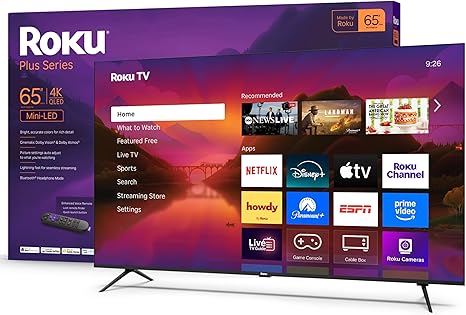
Welcome to Reviews inside tv — today I’ve got my hands on the Roku 65‑Inch Plus Series Mini‑LED Smart TV (2025), and I want to walk you through everything: what it claims to do, how it actually performs, where it shines — and where it doesn’t quite hit the mark.
This Roku Plus Series TV is a 65‑inch flat screen smart television with Mini‑LED backlighting, a QLED panel, 4K resolution, Dolby Vision, and Roku’s own smart TV platform. On the audio side, it supports Dolby Atmos and even has a built-in subwoofer, plus a voice remote that works with Roku Voice, Alexa, Google Assistant, and Siri. It’s also compatible with Apple AirPlay, so you can stream photos, videos, and music straight from your Apple device.
At its core, this TV aims to deliver a cinematic picture at a relatively accessible price, while giving you the streamlined Roku experience — lots of free content, an intuitive home screen, and automatic updates so new features keep coming without you having to lift a finger.
When you unbox it, the first thing that struck me was how sleek the design is: the screen feels very clean, minimal bezels, and a cable‑management clip on the back keeps things tidy if you’re wall-mounting. The stand is solid but low-profile, which works well on a media console. Setting it up was straightforward — Roku OS launched quickly, and connecting to Wi‑Fi was smooth. I didn’t experience any long waits or tricky installation steps.
In terms of picture, the Mini‑LED backlighting makes a real difference. In darker scenes, blacks appeared much deeper than on a typical edge‑lit LED screen, though it’s not quite OLED‑level pitch black. Because of the local dimming zones, the contrast felt very good, and I didn’t notice too much blooming around bright objects — but in very high-contrast scenes there’s still a little glow, especially if you’re sitting quite close.
Colour performance is pleasing: the QLED layer gives punchy, vibrant hues, particularly in HDR content. Dolby Vision kick‑started the more dramatic highlights, but I did notice the brightness peaks are more moderate compared to flagship Mini‑LEDs — in my viewing tests, HDR looked good in a living‑room environment but didn’t blow away more premium models in a really dark room.
On the motion side, this model has a 60 Hertz panel, which is fine for most TV watching — movies, streaming, live sports — but not ideal for high-end gaming where you might want 120 Hz or variable refresh rate. Input lag seems reasonable for casual gaming, but if you’re a hardcore competitive gamer, this might not be your dream spec sheet.
Audio is surprisingly good for a built-in set. The Dolby Atmos support gives a bit of spatial feel; dialogue is crisp, and the subwoofer helps with bass enough that for many viewers, an external soundbar might not be essential. I also tested the Bluetooth Headphone Mode, and it worked well — very useful for late-night watching without disturbing others.
Now, what really impressed me was Roku’s Smart Picture Max feature. This uses AI to analyse the incoming signal and dynamically optimise colour, sharpness, and contrast for each scene. In action, I watched a nature documentary and the difference was noticeable: bright highlights on water, foliage detail, and shadow areas all looked cleaner and more balanced than on a conventional 4K set. It’s not perfect — when there’s very fast action, the tuning feels reactive rather than predictive — but for everyday viewing, it genuinely elevates the image.
On the usability front, the Roku OS remains one of the most user-friendly platforms. With over 500 free channels and a wide variety of paid streaming apps, it’s easy to find what you want without clutter. The remote is well-designed: voice control is responsive, and you can set personal shortcuts for your favourite apps. There’s also a “lost remote” finder, which worked reliably when I hid the remote under the sofa (yes, tested that).
Of course, nothing’s flawless. One thing that bothered me was motion smoothing: according to some user reports, certain Roku TVs have motion interpolation (sometimes called “anti‑judder”) that cannot be disabled, which can make cinematic content look unnatural. That was noticeable in some cleaner, panned shots. If you’re someone who cares deeply about preserving the film-like cadence, this could be a real issue.
Also, while brightness is decent, as I said, it’s not at the level of premium Mini-LEDs like those from TCL’s higher-tier lines; so in very bright rooms it struggles a little more to deliver punchy HDR highlights.
The 60 Hz refresh rate limits its appeal for serious gamers. No HDMI 2.1 ports means you miss out on features like 4K at 120 Hz or variable refresh rate. If that’s a priority, you’ll need to look elsewhere.
Finally — build-wise — the materials feel sturdy, but this is very much a budget-to-mid‑tier set. The stand is not adjustable, and although the bezel is slim, the panel is thicker than a premium OLED or ultra-slim design. In terms of long-term reliability, Roku’s newer TVs are promising, but given this is a 2025 model, we don’t yet have years of real-world failure data. Roku’s reputation for affordable, reliable smart TVs helps give me confidence, however.
In terms of value for money, this TV lands in a sweet spot. On sites like Best Buy it’s listed at around $499.99 for the 65‑inch model. Given the specs — Mini-LED, Dolby Vision, Dolby Atmos, smart platform, built-in sub — that’s a very competitive package. For comparison, Hisense U8Q Mini LED TV offers stronger brightness and a 120 Hz panel, but costs significantly more. Meanwhile, mid-range Roku or TCL models that undercut this TV tend to use edge‑lit LED rather than Mini‑LED, sacrificing local dimming quality.
So if you want a premium-feeling picture without paying for a flagship, this Roku is a very smart pick — assuming you’re okay with its limitations in motion handling and gaming.
Putting it all together: this 65‑inch Roku Plus Series Mini‑LED TV is a compelling option for people who prioritize cinematic picture, smart interface simplicity, and value. It’s not perfect — particularly for motion purists or competitive gamers — but for most viewers who just want a sharp, colourful, and immersive experience, it delivers remarkably well for the price.
If you’re looking for a high-end gaming TV with HDMI 2.1, you might want to look at something like the TCL 4K Mini‑LED QLED Smart TV. But if you want solid HDR, Roku’s ecosystem, and great picture for streaming and movies, this Roku Plus Series set is very hard to beat for the money.
Thank you for watching Reviews inside tv. If you’re curious about picking this up, check the comments below — you’ll find helpful links. And if you already own one of these, let me know how it’s been for you: what you love, what surprises you, what annoys you. Good bye till next time — may your next binge-watch feel like you’re in a theatre, only without the sticky floors.
Available to buy here:


