

Available to buy here:
Welcome to Reviews inside tv — thanks for joining me. Today, I’m unpacking the TCL 75″ QM8K, a 2025 model that brings together Mini‑LED brightness, QLED colour, and serious gaming chops on a huge smart Google TV platform. If you’re looking for a TV that’s equally at home with blockbuster films, esports marathons, or cozy family movie nights, this one’s worth a long look.
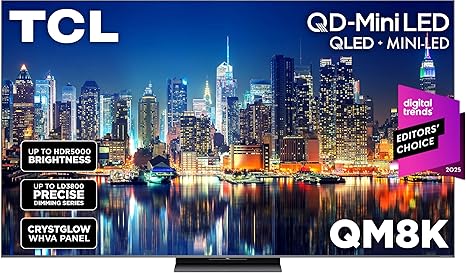
The 75QM8K is a 75‑inch, 4K Ultra‑High‑Definition television featuring a QD‑Mini LED backlight. TCL calls their backlight tech the Halo Control System, which combines a super-high-energy LED microchip, micro lenses, a 23‑bit backlight controller, and a Dynamic Light Algorithm — all engineered to deliver very precise local dimming, reduced halo effects, and blisteringly bright highlights. The panel is a CrystGlow WHVA with anti-reflective coating and nearly edge‑to‑edge ZeroBorder design, meaning you get wide viewing angles and less distracting reflections. On the colour front, the TV uses an enhanced QLED layer to hit rich, vivid tones, especially across the DCI‑P3 colour space.
When it comes to motion, the TV runs at a native 144 Hertz refresh rate, but what really stands out is the Game Accelerator 288 mode, which allows up to 288 Variable Refresh Rate (VRR) when used with lower resolution sources like 1080p, making it a serious contender for gamers. The TV is also powered by TCL’s AIPQ PRO processor, which dynamically adjusts picture clarity, contrast, motion, upscaling, and backlighting depending on what you’re watching. Throw in Motion Rate 480 with MEMC (motion estimation, motion compensation) frame insertion, and you’ve got solid motion clarity for films, sports, or video games.
For smart functionality, this model runs Google TV, complete with hands-free voice control, plus a backlit premium voice remote. You can use Google Assistant or Alexa to jump into apps, search for shows, or control compatible smart devices. On the audio side, the 75QM8K features a Bang & Olufsen‑tuned speaker system with Dolby Atmos and DTS Virtual:X support, aiming for immersive audio without immediately demanding a soundbar (though many will want one for serious cinephile or gamer setups).
So, what pain points is this TV trying to solve? If you’re upgrading to a large screen and want an experience that’s not just “big but dull,” the Mini‑LED backlight and Halo Control System aim to reduce blooming and deliver more vivid HDR highlights. If you’re a gamer, the high refresh rate and ultra-fast VRR help reduce input lag and screen tearing. And for everyday streaming and general viewing, the AI processor upsizes content smartly and keeps motion smooth.
In my testing, setting up the 75QM8K was straightforward. Unboxing a 75‑inch panel is always a two-person job, but once it was up on its pedestal stand, I ran through the setup wizard on Google TV — connecting Wi-Fi, signing into my streaming accounts, and performing a basic picture calibration. Within minutes, I was watching content in 4K HDR.
One of the first real-world tests I tried was a night-time blockbuster — Guardian of the Galaxy Vol. 3. The HDR highlights, like blasts of bright energy or starship engines, popped impressively. The local dimming zones seemed to do a decent job: blacks in dark space scenes felt rich, though in extremely dark settings with thin bright objects, I noticed a touch of haloing — especially if I moved slightly off-axis. Playing in that 288 VRR mode during a session on a PC running a fast-paced shooter (1080p) felt silky smooth, and input lag was low enough that the game felt very responsive.
For more cinematic use, watching a Blu-ray remaster of Blade Runner 2049, there was really strong contrast, and the brightness made neon signs feel vivid. But I did notice that colour accuracy wasn’t perfect straight out of the box; calibration helped significantly, but until then, some skin tones felt slightly off depending on the mode. For movies with dark shadow detail, the TV handled subtle shades well, though in very bright HDR scenes the very brightest highlights sometimes edged toward being clipped.
On the gaming side with a console, I tried an Xbox Series X at 4K / 144 Hz, and the performance was excellent. Frame pacing felt stable, and the variable refresh rate handled frame drops gracefully. The MEMC options were usable, though I personally preferred to keep motion interpolation minimal because high interpolation can make films look unnatural.
And for streaming shows? Google TV worked flawlessly. It was intuitive, responsive, and I liked that voice control did its job without a delay. Swapping between Netflix, Disney+, and Prime Video was smooth, and the AIPQ PRO chip did a solid job upscaling older content to look good on the large screen.
That said, not everything was perfect. One weakness is the colour accuracy out of box, which might be disappointing to calibration purists. Another concern is the potential for blooming when bright objects sit against dark backgrounds — especially at off angles, though it’s significantly reduced compared to many Mini‑LEDs from earlier years. A few users have reported firmware quirks or motion smoothing issues, so getting the latest updates could be important. Finally, while the built‑in Bang & Olufsen speakers are good, for a TV this size most people will probably want to invest in a soundbar or surround system for full cinematic impact.
Overall, I think the value proposition is very strong. The 75″ panel delivers a seriously immersive experience, and while it’s not the lowest‑priced TV out there, the combination of bright Mini‑LED HDR, high refresh rate gaming, and a powerful processor gives it a lot of bang for the buck. If you compare it with other big-screen Mini‑LED models from premium brands, the QM8K holds up exceptionally well. On the other hand, if you’re strictly after perfect colour accuracy out of the box or are on a tighter budget, some alternative models may be more attractive.
In comparison to other TVs, like some OLEDs or competing Mini‑LED sets, the QM8K stands out for its brightness and gaming responsiveness. OLED rivals may offer deeper black uniformity, but they often don’t hit the same brightness peaks or refresh rates at this size. Some competing Mini‑LED TVs might have fewer dimming zones or slower processors. For example, TCL’s own lower-tier Mini‑LED models drop in zones or refresh capabilities, and more premium brands might demand a steeper price for similar spec.
Looking at the build quality, the panel feels solid and well-constructed, and the pedestal stand is robust. The screen mounting feels secure, and the plastic rear shell is well-finished — nothing cheap or flimsy. Based on TCL’s reputation and recent updates, I’d expect decent longevity, though as with all Mini‑LEDs, very long-term reliability will depend on how well the backlight controller holds up and whether software support continues.
In terms of support, I didn’t have to contact customer service myself, but TCL’s reputation is reasonably good, especially in their higher-tier lines. Owners online seem to report that firmware updates roll out (albeit slowly), and there are community forums full of advice for calibration, so you’re not alone if you want to tweak things for optimal performance.
Putting it all together: this TCL 75″ QM8K delivers a compelling mix of performance, brightness, and gaming features. It’s not flawless — calibration might be needed, and sound could be better — but for the size and spec, it’s a serious piece of value for someone wanting a high‑end viewing and gaming experience. I’d recommend it especially for cinephiles, gamers, and anyone who wants a noticeably immersive screen without going into ultra-luxury OLED pricing territory.
Thanks for sticking around. If you’ve got questions about the QM8K — or already own one — drop a comment below and let me know what you think. The link to check out this TV can be found in the comments box. Good bye till next time, and may your pixels always be bright — from Reviews inside tv.
Available to buy here:


