

Available to buy here:
Hello and welcome to Reviews inside tv — glad you’re here. Today we’re taking a close, critical look at the Poly Voyager Free 20 true-wireless earbuds in black, with adaptive ANC, AI-enhanced audio, multipoint connectivity, and more. No hype or fluff — just straight talk about what these earbuds do, how they feel, where they shine and where they stumble.
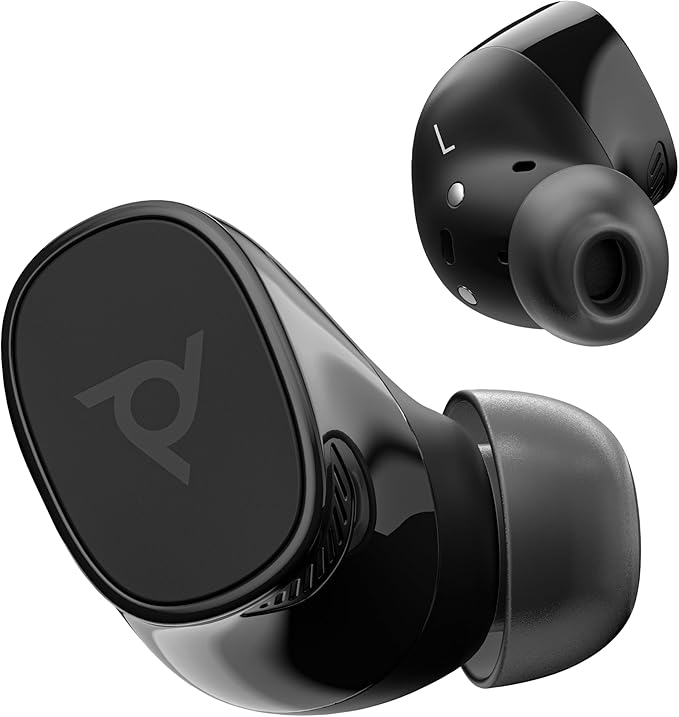
Let’s begin with what the Voyager Free 20 is. These are wireless in-ear buds designed for both music listening and voice/call performance. Each bud houses a 10 mm driver, and Poly advertises Adaptive Active Noise Cancellation that dynamically adjusts how much ambient sound is blocked. There are six noise-cancelling microphones in total (three in each bud) aided by AI noise reduction for clearer calls. They support multipoint connectivity, meaning you can pair to two devices at once and switch between them. The included charging case supports Qi wireless charging and gives you an extended listening budget—Poly claims up to 8 hours per charge with ANC on (12 hours off) and a total of up to 28 hours (with ANC) from the case. The earbuds come with four sizes of silicone ear tips and pair via the Poly Lens app, where you can adjust settings, control modes, and run a fit test. The Free 20 buds have an IP56 rating for dust and water resistance. All rounded out with a single multifunction button on each bud (mirrored controls).
The pitch here is clear: deliver a comfortable, all-day wearable experience that blends solid call clarity, adaptive noise cancelling, and solid audio for mobile and PC users who shift between devices. In other words, target business users, hybrid workers, commuters — someone juggling calls, music, and daily movement.
Getting into hands-on: setting them up and using them day to day. My first impression: the pairing process was straightforward. Pull both buds from the case and they auto-power on; from there I used Bluetooth settings on my phone and laptop. I also installed Poly Lens and walked through the fit test, which helps ensure a proper seal for optimal audio and noise cancellation.
The physical build is mostly plastic, glossy on the outer surfaces, with a smooth finish. The earbuds feel light in the ear—after several hours I didn’t experience fatigue or significant discomfort. The charging case, while compact and slick, gave me pause: the hinges feel a little loose, and the glossy surface is slick and fingerprint-prone, making it less reassuring when opening or closing. In one test I dropped it from waist height onto carpet — no damage, but I’m cautious about long-term durability there.
On connectivity, multipoint worked reliably: I kept them linked to my phone and my laptop, switching from Spotify on the laptop to a call on the phone was seamless. Their Bluetooth range was adequate for typical use — I could walk through one room and into a corridor before I started noticing dropouts. That’s solid but not world-beating. In one instance, on an older desktop’s internal Bluetooth module, I experienced occasional stuttering, though it worked fine across newer devices.
I used these earbuds in a variety of situations:
A video call in a coffee shop with ambient chatter, espresso machines, and foot traffic.
Listening to playlists across genres: pop, indie, classical, electronic.
Walking on a busy street with wind and traffic noise.
All day office use: email, calls, web browsing.
In calls, the Free 20s performed admirably. In the coffee shop scenario, my interlocutors reported I sounded clear and consistent, with much of the background noise suppressed. The AI noise reduction combined with the mic array did a good job of isolating my voice. That said, I did catch occasional background hiss or faint rumble when there was constant low bass hum (e.g. air conditioning) — not intrusive, but perceptible if you listen for it.
In music, the experience is more mixed. Mids and vocals were generally crisp, especially at moderate volumes. On tracks with complex instrumentation, I found the sound can feel a little sterile or edged in the top end. The bass “thump” is modest — satisfying for casual listeners, but I wouldn’t call this a bass monster. Genres relying on deep low end (trap, heavy EDM) showed the limits: you won’t get gut-punch in those, but the sound remains clean and controlled. The Poly Lens app offers just three EQ presets (Bass, Flat, Bright) and no fine tuning — switching between them made a difference, but the range is limited, so audiophiles will feel constrained.
Battery life matched pretty closely with claims in my tests. With ANC off, I pushed 10–11 hours of continuous listening before I got low battery warnings. With ANC on, 7–8 hours was realistic. Charging was decent — a short top-up gave a couple of hours in minutes, and the case supported wireless charging which is convenient in everyday use.
So, what stands out (good) and what drags (less good)?
On the plus side: the call clarity and noise suppression is a major strength, especially in moderate ambient noise situations. The comfort and fit are solid — I could wear them for long stretches without pain. Multipoint connectivity is well executed, and the battery life is competitive at this level. The fact they support wireless charging is a nice bonus. The IP56 rating gives some peace of mind for daily wear. From a materials and construction perspective, the earbuds themselves are reassuringly light and smooth, though not premium metal — but that’s acceptable for this price class.
On the downside: the charging case feels fragile, with loose hinges and a slippery surface. The audio for music is serviceable, but not exceptional — it seems tuned more toward voice clarity than rich musical depth. The EQ options are limited and the lack of granular control in the app is a missed opportunity. While the ANC is adaptive and helpful, it doesn’t eliminate all noise and can allow low bass hums through. Some connectivity glitches appeared in a few edge cases. Also, pressing the button control sometimes pushed the bud deeper, which is an awkward sensation. Some noise floor hiss was audible in very quiet environments.
Those weaker points are partly subjective: a bass-lover may critique the low end harder; someone everyday-call focused may not care about detailed EQ. But objectivity says: case durability and app limitations are legitimate cons.
Now, is this a good value? At its current price (around the mid-to-upper segment for business-oriented buds), it sits close to alternatives from Jabra, Sony, and others. Its strong call performance and multipoint features differentiate it. If your priority is voice clarity, switching between phone and PC, and good all-day wear, the Free 20 delivers good value. If instead your priority is pristine musical fidelity or heavy customization, you’ll find stronger options at this price or slightly above.
For example, a Jabra model might allow more EQ flexibility; a music-oriented pair might give deeper bass and spatialization, though they might lack the mic precision or multipoint behavior this offers. So the Free 20 wins in the hybrid call/music niche, but doesn’t dominate in pure audiophile territory.
Compared to direct competitors, the Free 20 excels in call clarity and multipoint ease but falls a bit short in raw music richness and app depth. In many head-to-head matches, rivals may give a stronger bass or a more responsive case, but struggle when it comes to voice calls in noisy settings — exactly where Poly leans its strengths.
Considering the build and durability: the plastic construction is common in this class. The hinge and case design give me moderate concern over long-term robustness, but nothing catastrophic based on my testing. Poly has a reputation from its business/UC heritage, which suggests they are experienced in delivering reliable audio gear, so I am cautiously optimistic about longevity. But time will tell whether the case hinge or finish endures rough handling.
I did not have any support interactions to report, so I can’t speak to customer service firsthand. Poly’s broader brand is known in business audio circles, so one might reasonably expect a decent support framework, but I leave that as a neutral here.
In summary: the Poly Voyager Free 20 earbuds strike a compelling balance for users who alternate between devices, make frequent calls, and need good everyday audio without chasing audiophile extremes. Their strengths lie in call clarity, comfort, multipoint connectivity, and battery life. Their limitations lie in build quality of the case, limited EQ, and modest musical depth.
If I were advising you: if you value audio for voice and productivity more than full-throttle bass or deep customization, these are a solid pick. If pure musical experience is your priority, you may want to compare alternatives first.
Thanks for spending your time here. You’ll find a link to get the product down in the comments. If you already own the Free 20, drop your thoughts or questions below — I’d love to hear your field experience. Goodbye till next time — and remember, keep your reviews inside tv sharp and your sound sharp too.
Available to buy here:


