

Available to buy here:
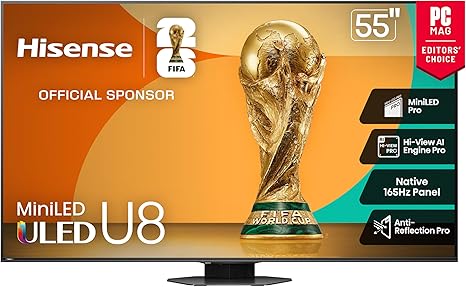
Welcome back to Reviews inside tv, where we break down the latest tech so you know what you’re really getting. Today, I’ve got something seriously eye-catching: the Hisense 55-inch U8 Mini-LED ULED 4K Google Smart TV — the 2025 U8QG model. It promises blistering brightness, pro gaming chops, and a cinema-style soundstage. So let’s unpack whether it lives up to the hype.
At its core, this is a mini-LED TV — meaning instead of a handful of large LED backlight zones, it’s lit by thousands of tiny LEDs. That’s paired with Full Array Local Dimming Pro, which is claimed to yield up to 5,000 nits of peak brightness and an astonishing 5,600 dimming zones. On paper, this translates to razor-sharp contrast, crisp highlights, and deep, accurate shadows — exactly what you want for both blockbuster HDR content and fast-paced gaming.
Inside, you’ll find Hisense’s Hi-View AI Engine Pro, a proprietary processor that dynamically analyses what you’re watching or playing and optimises both picture and sound in real time. For gamers, there’s a native 165 Hz panel with support for variable refresh from 48 Hz to 165 Hz, plus AMD FreeSync Premium Pro, Auto Low Latency Mode (ALLM), and motion-smoothing MEMC. There’s also a built-in Game Bar so you can tweak settings on the fly without pausing your session.
To manage reflections, Hisense has added Anti-Reflection Pro coating to the screen, meaning bright rooms—or a window behind you—won’t completely wash out the image. On the audio side, it’s not just a flat TV speaker setup: this model features a 4.1.2-channel configuration, with left/right main, surround left/right, a built-in subwoofer, and two up-firing speakers. That supports Dolby Atmos and IMAX Enhanced, giving a more immersive, home-theater style sound.
In terms of color, the panel is QLED (quantum-dot), and Hisense says it’s Pantone-validated, promising very accurate, richly saturated colors. HDR formats supported include Dolby Vision IQ, HDR10+ Adaptive, HDR10, HLG, and Advanced HDR by Technicolor. There’s also a Filmmaker Mode, which lets you view content in the aspect ratio, color, and frame rate intended by the creators.
On connectivity, you get three HDMI 2.1 ports, a USB-A 3.0 and USB-A 2.0, an optical audio output, 3.5 mm headphone jack, Ethernet, Wi-Fi (likely Wi-Fi 6E), Bluetooth, and eARC. Smart functionality is handled by Google TV, so you have access to all major streaming services, voice control via Google Assistant, and casting.
When I first got the Hisense U8QG set up, I was struck just by the brightness. It’s not a subtle glow — even in a well-lit room with daylight streaming through the window, highlights pop. That anti-reflection coating helps a lot: glare is significantly reduced, so even screens with white text or bright scenes stay readable. Setting it up was straightforward — the pedestal stand is solid, and the UI booted quickly into Google TV.
In testing, I tried three core scenarios: HDR movie watching, fast-paced gaming, and day-to-day TV streaming.
HDR Movies: Watching a space-opera style film, the mini-LED shine made cosmic effects feel dazzling. Explosions and star flares glowed with intensity, and black levels held up well thanks to the local dimming. There was minimal haloing around bright objects, though on very dark scenes with tiny bright spots, you could just about catch a little blooming if you looked closely. The sound design was immersive — you really felt the subwoofer kick in during big action beats, and the up-firing speakers added a sense of height to the Atmos mix.
Gaming: Plugging in a next-gen console, the 165 Hz native refresh was visibly smoother than a regular 120 Hz or 60 Hz screen — menus scrolled like butter, and fast reaction combos felt more immediate. I enabled VRR (variable refresh) via FreeSync Premium Pro, and I saw reduced tearing with no noticeable input lag. The Game Bar was very handy: I could tweak brightness, latency, and black levels without leaving the game, which is a nice touch for competitive sessions.
General Streaming / TV: For my regular Netflix, YouTube, and news channel watching, the AI Engine Pro did a decent job of upscaling and balancing contrast. Colors looked bold but not oversaturated. For sports content, motion-handling was impressive, though in very rapid camera pans there was just a little softness — not a dealbreaker, but noticeable if you’re watching things like tennis or football.
The strengths of this TV are clear. The brightness is its standout claim — having such high peak luminance means HDR really shines, especially in bright rooms. The native 165 Hz panel and gaming features make it a strong pick for serious gamers. The audio gives more than the typical built-in TV speaker, with real up-firing channels and a subwoofer to back it up. And because it uses Google TV, it has a very mature smart platform with good app support.
That said, it’s not perfect. While its local dimming zones are huge in theory, in practice you can sometimes see blooming around very bright small objects on a dark background. Off-axis viewing isn’t great: if you move too far left or right, black levels and contrast suffer, especially on this panel type. Some users report that while the subwoofer delivers power, it distorts a little at the very lowest frequencies. And there are a few reports of panel uniformity issues (dirty screen effect) — not every unit is perfect.
So, is the value for money there? That depends on your priorities. On price: mini-LED TVs with this level of brightness and dimming sophistication tend to sit in a premium-but-not-premium-premium bracket. If you compare with other high-brightness displays (for example some OLEDs or other flagship mini-LEDs), the U8QG is competitive. For gamers wanting serious performance without dropping into ultra-premium brands, this is a really attractive option. However, if you’re someone who prioritizes perfect uniformity, or you’re planning to do most of your watching in a dark, cinema-style room, you might find something more consistent — though likely more expensive — elsewhere.
In terms of alternatives, here are a few worth considering:
Hisense U8N (2024 model) — a similar form factor but slightly lower spec in brightness or dimming zones; cheaper, but you give up some of the “pro” advantages.
TCL’s higher-end mini-LED models — depending on region, TCL offers competitive brightness, but sometimes with fewer zones or slightly lower refresh rates.
OLED TVs from LG or Sony — if pure black-level performance and viewing angle matter most, an OLED could beat the U8QG in dark-room viewing, though you lose out on the same high peak brightness and possibly the same gaming refresh rate.
Looking at build quality and longevity, Hisense’s construction here feels solid: the chassis is well built, the stand is sturdy, ports are well placed. Mini-LED, by design, tends to be more thermally efficient than older LED-backlit designs, so long-term reliability is promising — though as with any LED-based TV, the control of backlight and power draw is key. Hisense’s brand reputation is improving, but as with new tech there’s always a risk — especially with uniformity on mass-produced sets. That said, the value proposition suggests it’s a risk worth taking for many.
From a customer support standpoint, I have not personally needed to open a ticket, but owners’ experiences seem mixed. Some users report prompt replacements or fixes under warranty, others mention quality control issues that required service. That mirrors a lot of big-brand TV feedback: you sometimes get a flawless set, other times a unit that needs some attention. Hisense does offer standard warranty coverage and has a growing service network, but it’s worth checking the exact terms in your country before purchase.
Here’s my final verdict: The Hisense 55″ U8QG Mini-LED is a seriously powerful performer. It delivers blinding HDR highlights, strong gaming capabilities with its 165 Hz native panel and VRR, and surprisingly immersive built-in audio. Yes, there are some trade-offs — a little blooming, off-angle weakness, and potential uniformity variance — but for the price and what you’re getting, it’s hard to beat if you’re after a premium gaming / bright-room HDR TV that doesn’t cost as much as ultra-high-end OLEDs.
If you’re a gamer, a film buff who watches in well-lit environments, or someone who values peak brightness over absolute perfect blacks, this is a very compelling pick. But if your main use case is cinematic viewing in a dark room, or you’re very sensitive to any blooming or panel imperfections, it’s worth comparing with high-end OLED or other mini-LED sets.
Thanks for hanging out with me on Reviews inside tv. If you’re curious about where to pick up this TV or want help comparing with other models, check the comments below – I’ll do my best to help. Thanks for watching, and until next time — keep your picture sharp and your reviews inside!
Available to buy here:


