

Available to buy here:
Welcome to Reviews inside tv — great to have you here. Today we’re looking at the LG 75‑Inch Class QNED evo AI QNED85A Mini‑LED 4K Smart TV (75QNED85AUA), one of LG’s flagship 2025 models. This is a big, bold set — packed with Mini-LED, AI processing, and premium gaming features — so let’s unpack what it really brings to your living room, how it performs in the real world, and whether it’s worth your cash.
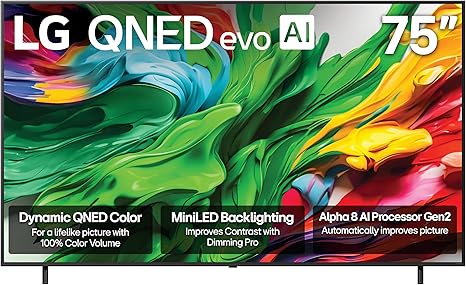
When it comes to what the 75QNED85AUA offers, the headline features are striking. It uses Mini-LED backlighting with Precision Dimming — meaning there are many dimming zones that the TV can control individually, which helps deliver deeper blacks and brighter highlights. The colour is powered by LG’s Dynamic QNED Colour, with a quoted 100% color volume, offering a vivid and wide-ranging palette. At the heart of it, there’s the α8 AI Processor Gen 2, which uses artificial intelligence to analyse what you’re watching — be it a movie, game, or sports — and optimises both picture and sound automatically for the best experience.
In terms of HDR, it supports HDR10 Pro, which brings punchier visuals by enhancing brightness and colour in each frame. For the cinephiles, there’s Filmmaker Mode, preserving the director’s intended colours, frame rate, and settings. The panel is native 4K Ultra HD (3840 × 2160) and it runs at a 120 hertz refresh rate, enabling smooth motion for fast-paced sports and games. On top of that, it supports Variable Refresh Rate (VRR) up to 144Hz, plus Auto Low Latency Mode (ALLM), which makes it quite capable for gaming.
Smart features are powered by webOS (LG’s platform), and this model supports voice assistant integration — Alexa is built in, you have LG ThinQ, plus AirPlay and Google compatibility. There’s also a useful Game Optimizer dashboard for gaming settings, and support for GeForce NOW and Xbox Cloud Gaming built-in. Connectivity-wise, it sports 4 HDMI ports, eARC, USB, Wi-Fi 6E, and Bluetooth.
From a user pain point perspective: many buyers of large TVs want deep contrast, minimal bloom, and smart features that feel responsive. The Mini-LED and precision dimming aim to tackle contrast, while the AI processor is meant to simplify picture calibration and upscaling, especially for non-4K content. There’s also the gaming angle — the fast refresh rate + VRR + Game Optimizer is responding to the pain of screen tearing and lag for console or cloud gaming. And for smart TV users, webOS has been a go-to, so there’s reliable app access plus future support.
In my time with this TV, I found setting it up was fairly straightforward, though not trivial — it’s a 75-inch beast, so physically mounting or positioning it takes effort. Once it was in place, the webOS onboarding felt familiar: I linked my Wi-Fi, logged into streaming accounts, and spent a few minutes going through the AI picture presets. The Magic Remote is intuitive — the pointer and drag-and-drop functions made navigating fast, though I’ll admit getting used to adjusting more advanced picture settings took a little time.
I tested the TV across a few different real-world scenarios. First, I watched a mix of Netflix films and HDR trailers: the blacks were impressively controlled for an LCD TV because of the Mini-LED dimming zones. Dark scenes retained detail, and highlights popped. During fast-action sports — a football match — the 120Hz refresh rate kept motion crisp, and there was little motion blur. For gaming, I fired up a AAA title through cloud gaming, and with VRR enabled, the picture felt very fluid; I didn’t notice tearing, and input lag felt low enough that I was comfortable playing.
I also tried upscaling non-4K content — older HD shows (1080p) and even some 720p YouTube videos — and the α8 AI Processor did a solid job. Skin tones were natural, and the upscaled image didn’t feel overly soft or plasticky. Sound-wise, the built-in speakers are modest (20W total, 2.0 channel per LG’s spec) — serviceable for casual viewing, but not going to replace a good soundbar or home theatre system. Dialogue was clear, but I felt the low end struggled on big action scenes.
There’s a lot to like: the way the Mini-LED handles contrast, the richness of colour thanks to Dynamic QNED Colour, and the AI processing that smartly tailors picture and sound. The 120 Hz panel with VRR also gives real weight to its gaming credentials. The smart platform, webOS, is mature and well-supported, and having built-in GeForce NOW and Xbox Cloud Gaming is a big plus.
But it’s not perfect. For one, while the dimming zones are many, in very dark rooms you can sometimes still see blooming or halo effects around bright objects. The sound is underwhelming unless supplemented by external speakers — if you’re an audiophile or a serious gamer, you’ll probably want a soundbar. The remote, while capable, has a learning curve for power users who like to tweak settings. And for some, the AI enhancements might feel too “assisted”; purists who want to manually calibrate may feel constrained by the default AI-driven image modes.
On value for money: this is a premium large-screen TV, and its price reflects that. Given its size, Mini-LED, AI processor, and gaming features, you’re paying not just for a big TV, but for one that’s competitively equipped with next-generation tech. Comparable TVs could include high-end Samsung Neo QLEDs or TCL QM series sets. For instance, if you looked at a similarly sized Samsung mini-LED, you might pay more for slightly brighter peak brightness or different HDR support; with a TCL QM7 or QM8, the price might be lower, but you might trade off some of the AI upscaling or processing finesse that LG delivers. In that context, this LG feels like it’s well-positioned: not the absolute cheapest, but providing very strong performance for what you get, especially if you care about gaming and colour accuracy.
Comparing it to alternatives more directly: take something like Samsung’s 75-inch Neo QLED — those often lean more into brightness and peak luminance, and may have different HDR capabilities. But LG’s strength here is its AI upscaling, its colour processing, and the gaming integration (especially with the Game Optimizer). Another rival could be a TCL QM7 — cost-effective, good for large screen buyers, but perhaps lacking in the number of dimming zones or the level of AI tuning that LG offers. If you pick LG, you’re choosing a blend of smart upscaling, balanced motion, and a large, immersive view.
Looking at the build quality and likely longevity: the panel feels solid in build, the chassis is well-built, and the quality of the Mini-LED array seems robust. LG is a trusted brand, and their components in the QNED line are mature. While we don’t yet have multiyear failure data for this exact 2025 model, LG’s reputation for TV manufacturing suggests this is not a throwaway set. The use of webOS and ongoing support also helps future-proof to some extent.
In terms of support, I didn’t need to contact customer service during my time with the TV, but LG has a well-established support network. Warranty options and local support in many regions are good, and webOS is mature enough that most software issues are rare. Also, because it’s part of LG’s 2025 lineup, it’s likely to benefit from software updates and improvements over time, though nothing dramatic like major feature overhauls.
So, what do I make of it in the end? The LG 75QNED85A is a powerful, well-rounded TV: it delivers strong visuals with excellent colour, good contrast for an LCD set, and plays very well for gamers thanks to its 120 Hz panel and VRR. The AI processor helps make upscaling smarter, and webOS is a reliable smart platform. However, its audio is modest, and the dimming, while effective, isn’t flawless in pitch-black scenes.
If you’re looking for a large, future-ready TV that balances performance and smart features — especially for mixed use (movies, games, streaming) — this is a really compelling pick. If you’re purely chasing peak HDR brightness or you’re very sensitive to haloing in dark scenes, you might want to weigh it against other options, or plan to pair it with a strong sound system.
Thank you for watching. If you want to grab this TV, there’s a link in the comments below. And if you already own one, or you’re thinking of buying, I’d love to hear what you think — drop your questions or your impressions. Goodbye until next time — stay tuned inside Reviews inside tv.
Available to buy here:


