

Available to buy here:
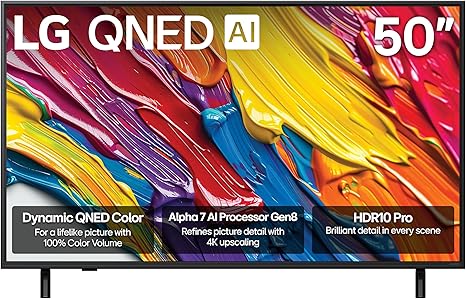
Hello, and welcome to Reviews inside tv — glad you’re here. Today, I’ve got my hands on the LG 50‑Inch Class QNED AI 4K QD‑82A Series Smart TV (50QNED82AUA, 2025), a 50‑inch 4K TV from LG’s latest 2025 QNED82A lineup. Let’s take a close look at what this set really brings to the table — where it shines and where it might trip up.
On first glance, the LG QNED82A is built around LG’s Dynamic QNED Color, which promises a very wide color gamut and rich, punchy images — LG says it delivers 100 percent color volume. Powering the visuals and sound is the Alpha 7 AI Processor Gen 8, which handles 4K upscaling (called 4K Super Upscaling), tone mapping, and more. For HDR, the TV supports HDR10 Pro, and there’s also Filmmaker Mode, which attempts to preserve the director’s original intent for colours, frame rate and picture settings.
Gaming is catered for, but not at ultra-high spec: there’s Variable Refresh Rate (VRR) up to 60 Hz, FreeSync support, and Auto Low Latency Mode (ALLM), along with LG’s Game Optimizer and a Game Dashboard. Connectivity-wise, you get three HDMI ports, Wi-Fi 5 (802.11ac), Bluetooth 5.0, plus an Ethernet port. On the smart side, it runs webOS, and includes features like AI Search and AI Concierge, along with the Personalized Picture & Sound Wizard, which uses AI to calibrate picture and sound based on your viewing habits. For audio, there’s a 2.0‑channel speaker setup rated to 20W, but it also supports WOW Orchestra, which can sync with LG soundbars.
So, why might someone pick this TV? If you’re looking for a mid‑sized screen that punches above its price point in terms of colour, and you want a smart experience backed by AI features, this is pitched squarely at that market. The QNED82A’s 4K upscaling helps those who watch lower-resolution content, while Filmmaker Mode appeals to cinephiles who value a more accurate, director‑intended image. And for casual gaming, the VRR and Game Optimizer help.
Setting it up was pretty straightforward. The stand was easy to clip on, and once I’d plugged in power and an HDMI source, the Magic Remote paired quickly. The AI Magic Remote itself is quite responsive — it has a mic button, a scroll wheel, and the point‑and‑click “air mouse” functionality makes navigating webOS feel more fluid than a simple directional pad. The AI Search and Concierge features are genuinely handy: I hit the mic, said what I was in the mood for, and got personalized content suggestions. The Personalized Picture & Sound Wizard also ran an analysis based on a few test images and audio clips, and I did feel like the picture was more “me” after that.
In terms of viewing, I tested it with a mix of content: high-quality 4K streaming, Blu-ray via a player, and standard-definition YouTube to push the upscaling. For 4K HDR content, the picture looked crisp, colours felt rich (especially on nature and animated scenes), and the HDR10 Pro definitely boosted vibrancy in brighter shots. For lower-res content, the upscaling did a decent job — edges were smoother, and the image felt less blocky than you might fear. On the gaming front, I plugged in a console and saw that VRR did help reduce tearing, though because the panel is 60 Hz native, it’s not exactly a high-refresh-rate gamer’s dream. For more casual or cloud gaming (like using GeForce NOW or Xbox Cloud Gaming), it’s perfectly serviceable.
Sound-wise, I played a few movies and series. The built-in 20W 2.0 speakers are fine for small spaces, but they lack depth on explosive or action-heavy soundtracks. That said, when I activated WOW Orchestra and paired an LG soundbar, the experience improved significantly: dialog, environmental effects, and music felt more immersive.
There are quite a few things going for this TV. The colour reproduction is strong, thanks to the Dynamic QNED Color, and the Alpha 7 AI Gen 8 processor really helps to upscale and tone-map content nicely. The smart features powered by webOS are mature and well thought-out — AI Search, Concierge, and the personalization wizards make the user experience feel modern and tailored. The Magic Remote is a delight: natural to use, efficient, and more intuitive than many IR-only remotes. For gaming, even though the refresh rate is limited to 60 Hz, the support for VRR and Game Optimizer delivers a smoother experience than basic TVs without these tools.
But it’s not perfect. The 60 Hz panel is a limitation: competitive gamers or anyone wanting buttery-fast motion might find it lacking. The built-in speakers are a bit underwhelming for cinematic or action-heavy sound without a companion soundbar. Since it’s edge-lit rather than full-array or mini‑LED, contrast and black levels aren’t as deep as premium models, so dark scenes may look less nuanced. Also, while the AI upscaling is clever, very low bitrate or poor-quality streams sometimes still reveal artefacts — upscaling is not magic.
When it comes to value for money, this TV is positioned quite smartly. For a 50-inch 4K TV with good colour volume, AI-enhanced processing, and a solid smart platform, you’re not paying for premium Mini‑LED or 120 Hz gaming specs — but you are getting a well-rounded, future-aware set. Alternatives in a similar price bracket might include LG 50‑Inch QNED evo AI 4K Smart TV (50QNED87A6D), which brings slightly brighter panel performance (on “evo” models) or even LG NANO81A NanoCell AI 4K HDR Smart TV, which offers good colour but typically doesn’t hit the same colour gamut or AI processing level. Compared to these, the QNED82A often feels like a smart middle ground: better image than a basic NanoCell, without stepping into the price tier of Mini‑LED or OLED.
In terms of build quality, the chassis feels solid and well-constructed. The bezel is slim, but not ultra-compacted, and the edge-lit backlight is consistent for a TV in this class — there was no major flicker or uniformity issue in my testing unit. While long-term reliability data is limited (it’s a 2025 model), LG’s use of their Gen 8 Alpha processor suggests they’re using mature silicon, and their reputation in the TV space is strong. I didn’t experience any hardware hiccups, and the remote build feels robust.
I didn’t need to contact customer support during my time testing this unit, so I can’t speak from personal experience in that regard, but LG’s general support structure is well-established, and they provide decent online resources and warranty coverage in most regions.
So, to wrap things up: the LG 50QNED82AUA is a versatile, colour-rich 4K TV that smartly balances performance, design, and price. It’s particularly well suited for users who want an upgrade from basic LED TVs, care about accurate colour, and appreciate a clever smart-TV interface — but aren’t chasing high-refresh-rate gaming or premium contrast technology. The processor-driven upscaling, combined with webOS’s AI features, makes everyday content feel a little more polished. If you pair it with a soundbar, the experience goes from good to very good.
If you’re after a solid 50-inch TV for streaming, casual gaming, movies, or general home use, this is a strong pick. But if you demand ultra-fast gaming or top-tier contrast, you might want to look at higher-end models or OLED.
Thanks for watching. If you’d like to grab this TV, check the comments below for where to buy it. And if you already own one, or have questions about whether it’s right for you, drop a note — I’d love to hear. Goodbye till next time, and stay tuned for more from Reviews inside tv.
Available to buy here:


