

Available to buy here:
Here’s the review for the LG 42‑Inch OLED evo C5 (OLED42C5) on Reviews inside tv:
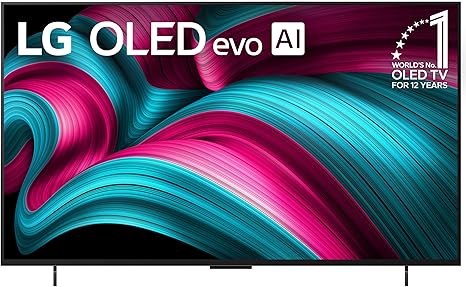
This is Reviews inside tv, and today I’ve got something a little different — the LG 42‑inch OLED evo C5, model OLED42C5PUA. It’s a compact OLED TV, but don’t let the size fool you: packed into that 42‑inch frame is some seriously high-end technology.
The C5 42″ runs on LG’s α9 AI Processor Gen 8, which powers their AI Super Upscaling 4K, and delivers image processing that adjusts for clarity, depth, and tone. Its OLED panel features over 8.3 million self-lit smart pixels, giving you perfect black and rich colour — the kind of contrast people expect from OLED but done here in a smaller footprint. It supports Dolby Vision, HDR10, and HLG for a broad HDR experience, and for film buffs there’s Filmmaker Mode which turns off motion smoothing to respect the director’s intent.
On the audio front, it’s not left wanting: you get Dolby Atmos, plus LG’s AI Sound Pro, which up‑mixes to a virtual 11.1.2 output, and a WOW Orchestra feature that makes sound feel more immersive. It also has a Personalized Picture & Sound Wizard — AI analyses what you watch and tailors both picture and audio settings to your tastes.
Gaming is a big part of this TV’s appeal: there are four HDMI 2.1 ports, all capable of high bandwidth (48 Giga bits per second), allowing for 4K at 120 frames per second and VRR up to 144 Hz when connected to a compatible PC. It supports NVIDIA G-Sync, AMD FreeSync Premium, and variable refresh rate. The TV’s response time is claimed at 0.1 milliseconds, so in theory it’s very responsive. On top of that, the Game Optimiser and Game Dashboard give you real-time control over settings like input latency, VRR, or picture modes.
The screen is native 120 Hz, but when used with the right PC setup, it supports up to 144 Hz in VRR mode. The panel tech is WOLED (not the newer RGB tandem panel), but still delivers very good motion and colour fidelity. The smart platform is LG’s webOS 25, giving you a familiar, responsive interface to navigate apps. And there’s an automatic “Pixel Cleaning” function for OLED panel care, helping to reduce risks of image retention over time.
When I set it up, I was pleasantly surprised: the stand is solid, it doesn’t feel flimsy, and the TV itself is surprisingly light at around 9.8 kg without the stand. Plugging in my PC, PS5, and Steam Deck was seamless — with all the HDMI 2.1 ports, I didn’t have to juggle inputs. I tested it across three main use cases: movies, console gaming, and PC gaming.
For movies, I watched a few HDR‑heavy scenes, and the blacks were deep, absolutely inky, and the Dolby Vision content looked rich, but not oversaturated. Filmmaker Mode was a treat — the picture felt “correct,” not overly smoothed or artificially sharpened, and that subtle tone mapping made darker scenes genuinely atmospheric.
On console gaming (PS5), running the TV at 120Hz felt smooth, and with ALLM enabled, it switched into a low-latency game mode automatically. In fast-paced racing games, motion was crisp, and the response time seemed good: I didn’t see noticeable blur or ghosting. On the PC side, I pushed the refresh rate to 144 Hz using my GPU, and with VRR on, there was very little screen tearing — though in a few more extreme graphic moments I did notice slight jitter, but that seemed more GPU than TV-related.
Soundwise, the 20 W, 2.0‑channel speaker system surprised me. It’s not going to replace a soundbar, but with Dolby Atmos content, the virtual 11.1.2 upmixing combined with AI Voice Remastering made dialogue crisp and clear, and ambient sounds felt more spacious than I expected.
There are many things to like, but it’s not perfect. On the plus side, the OLED panel gives stunning contrast, the processor is powerful and tuned well, and the gaming features are top-tier for a TV of this size. The build feels premium: the combination of metal and plastic gives a solid feel, and cable management around the stand is decent. The webOS 25 interface is snappy, and I liked how the Personalized Wizard tailored settings to my own viewing habits.
On the downside — and this is where some users may feel differently — brightness on a 42″ OLED is more limited than on larger OLEDs, so in a very bright room it doesn’t punch as hard. While the response time claim of 0.1 ms sounds amazing, real-world input lag (especially for competitive gaming) felt good but not “pro-gaming monitor” level, depending on your GPU and HDMI cable quality. And while the sound is surprisingly good, bass is missing; for movie lovers or gamers you might want a sub or soundbar to complement it.
There have also been some reports from early users of issues — for example, after firmware updates, some mention input lag concerns, or slight colour tinting, though others say updates have addressed many of these. Some users report flickering on 144Hz VRR over HDMI when used with certain GPUs, which could be a cable or firmware issue. But LG seems to be actively supporting the model, and the community is engaged.
In terms of value for money, this TV is priced toward the premium end for a 42‑inch model. But considering what it offers — self‑lit OLED, advanced gaming features, four HDMI 2.1 ports, Dolby Vision, Atmos, and the α9 Gen 8 processor — it’s competitively placed. Compared to a traditional gaming monitor, you’re paying more than many 27″ or 32″ monitors, but you’re getting a full TV experience with much more screen real estate. Compared with other OLED TVs, like LG’s own older C4 series, it’s worth considering whether the newer AI enhancements, slightly better brightness, and Gen 8 processor justify the premium. The LG OLED evo C4 42″ is cheaper in many places if you don’t need the absolute latest processing power. On the other hand, larger OLED TVs like the 55″ C5 or the G-series from LG cost significantly more if screen size is more important than desk use.
In comparison to other 42‑43″ TVs, the LG C5 stands out because there aren’t many competitors with true self-lit OLED at this size and this level of gaming connectivity. Some QLED or Mini-LED TVs in this size bracket may offer higher brightness in HDR or lower input lag, but they can’t match OLED’s contrast.
Looking at build quality and longevity: the TV feels well built, with a robust design and quality materials. The OLED panel is standard WOLED, not the more exotic tandem-panel tech, which means it’s mature and well-understood in terms of burn-in risk; plus the Pixel Cleaning helps. LG’s reputation for reliability is solid, and their service network is extensive, so long-term support should be good.
On customer support, I haven’t had to contact LG personally, but according to other users, LG’s service for OLEDs tends to be professional. They’ve been pushing regular firmware updates for their 2025 line, which is a good sign that they intend to support and refine these TVs over time.
Summing it all up, the LG 42‑inch OLED evo C5 is a remarkable piece of hardware. It brings premium OLED contrast in a compact form, excellent gaming credentials with 144 Hz VRR, and smart AI tuning for both picture and sound. It may not be the brightest in very sunny spaces, and the speakers are modest, but for someone who wants a high-end, compact OLED for mixed use — console, PC, and movies — it hits a beautiful sweet spot.
If I were recommending it, I’d say: go for this if you want top-tier picture quality and smooth gaming in a small footprint, and you’re okay adding a soundbar for deeper audio. If you’re just using it for daytime TV in a bright room or you’re after extreme graphics performance like a pro monitor, you might want to compare alternatives or a larger screen option.
Thanks for watching; I really appreciate you spending time here on Reviews inside tv. If you’ve got any questions about this OLED — or if you already own one — drop me a comment below. Thanks again, see you next time on Reviews inside tv!
Available to buy here:


