

Available to buy here:
Welcome to Reviews inside tv — today I’ve got something huge to talk about: the TCL 75‑inch T7 Series 4K QLED Google TV (model 75T7), the 2025 model with a 144 Hertz panel and some seriously gamer‑friendly credentials.
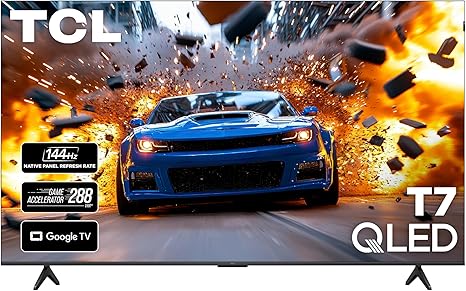
Right off the bat, this is a big television in more ways than one: a native 4K UltraHD (3840×2160) resolution, Quantum Dot technology (QLED) delivering rich, vibrant colour over nearly the full DCI‑P3 gamut, and a blisteringly fast 144 Hertz refresh rate on the 75-inch version. On top of that, TCL packs in its AiPQ Pro Processor, which optimises colour, contrast, and clarity in real-time, plus support for a broad set of HDR formats — Dolby Vision, HDR10+, HDR10, and HLG. There’s also motion-enhancement tech (they call it Motion Rate 480 with MEMC frame insertion), Auto Low Latency Mode (ALLM) for gaming, and a “Game Accelerator” featuring up to 288 VRR (Variable Refresh Rate) on some sizes. Sound-wise, it supports Dolby Atmos through its 2.0‑channel speaker system. In terms of connectivity, you get four HDMI ports (one with eARC), USB, Ethernet, plus Wi-Fi 5 (802.11ac). It’s a Google TV set, so you have Chromecast built-in, Apple AirPlay 2, and voice control via Google Assistant, Amazon Alexa and compatibility with Apple HomeKit. Design-wise: a FullView 360 metal, nearly bezel-less design, and adjustable-width feet, so you can fit it neatly onto different TV stands.
Why would someone pick this over other sets? Well, if you’re watching sports, racing games, or any kind of fast action, that 144 Hz refresh rate promises to cut down on motion blur. For gamers, the VRR + ALLM combo is impressive on a mid‑range big-screen set. For movie lovers, the broad HDR support and QLED’s strong colour performance are compelling. And for people who stream a lot of different sources? Google TV gives you massive app coverage plus voice‑control convenience.
So, how did it perform in my hands? Setting it up was pretty straightforward but not trivial — transporting and mounting a 75-inch panel is always a mission. The feet are adjustable, which helped a lot when placing a soundbar underneath, and the menu walked me through input setup and Wi-Fi connection quite smoothly. Once connected, I ran a series of stress tests. First, I streamed a fast-paced action movie, then jumped into a couple of AAA games (console and PC), and finally tried out standard TV viewing and YouTube. In the movie, the combination of high brightness LED backlight and QLED colour really made the highlights pop — explosions and city lights looked bold and glowing. In games, the 144 Hz refresh rate and VRR made a real difference: input felt responsive, motion looked fluid, and I didn’t catch as much screen tearing. Using ALLM, the TV automatically switched into a lower-latency mode whenever I booted a game, which was seamless. For everyday viewing, like YouTube or streaming services, performance was solid: Google TV ran apps smoothly, and the built-in Chromecast / AirPlay 2 gave me easy flexibility for casting. The Dolby Atmos came through decently for the built-in speakers — the sound wasn’t earth-shattering, but for a TV itself, the spatial feel was quite respectable.
Of course, there are trade‑offs. On the plus side, the picture clarity is excellent for fast motion, the AiPQ Pro processing delivers good dynamic contrast, and the Google TV interface is powerful and flexible. The voice remote with backlighting is handy in dim rooms. But the speakers are only 2.0‑channel, which limits bass depth unless you pair it with a soundbar. While the brightness is good, it’s not on par with high-end Mini-LED or OLED TVs for HDR peak luminance. Also, the 75-inch size demands space, and not everyone has a room that can accommodate it comfortably. There are also some reports from users online about issues hitting native 144 Hz under certain PC / GPU configurations, so it’s something to be wary of depending on your setup.
In terms of value for money, assuming the price lands close to what TCL has indicated (around a sub‑$1,000‑plus region in some markets, though that depends), this TV offers extremely competitive specs for its size. For similar money, you might find smaller TVs or larger TVs with fewer gaming features — so TCL is bringing serious value here for gamers and home cinema fans alike. An alternative could be something like the TCL 75″ 4K QLED Pro 120 Hz 75A300W, but that model has a lower 120 Hz refresh rate and doesn’t match the T7’s gaming‑centric features. On the premium end, MinI‑LED TVs or OLEDs will offer superior contrast or local dimming, but they typically cost a lot more, especially at this 75‑inch size.
Looking at build quality, the design feels premium: the metal bezel‑less frame feels solid and modern, and the adjustable-width feet are a thoughtful touch for furniture flexibility. TCL’s reputation in recent years has been improving, and while we don’t yet have years of long-term reliability data for this exact T7 model (since it’s quite new), the brand’s history with large‑screen QLEDs has been decently robust. As it’s a 2025 model, long-term user data is limited, but early signs and the build feel suggest it’s not a cheaply made set.
I haven’t personally needed to call customer support for this unit yet, so I can’t speak directly to my own experience. But TCL generally has a reasonable support infrastructure, and their website offers firmware updates, warranty coverage, and user guides. Given the product and the company’s track record, support should be solid — though as always with big TVs, you’ll want to take care during unboxing and installation.
I didn’t notice any major firmware quirks during my time with the TV; the interface was stable, and video playback was smooth. Whether software updates will substantially change future performance remains to be seen, but for now, the user experience is clean.
So, where does all that leave us? This TCL 75″ T7 Series really nails the sweet spot for someone who wants a massive screen, excellent motion handling, gaming chops, and solid HDR — without paying flagship‑tier prices. It excels in fast action, is plenty bright for living rooms, and offers great flexibility through Google TV plus voice assistants. The main compromises are in built‑in sound and perhaps peak HDR brightness, but if you’re prepared to pair it with a soundbar and set realistic expectations for HDR, it’s a very compelling pick.
If you’re a gamer or movie buff who wants a cinematic experience without the ultra-premium bill, the 75T7 is absolutely worth your consideration. If you lean more towards ultra-deep blacks and top‑tier HDR, you might still look at higher-end Mini‑LED or OLED alternatives — but you’ll likely pay quite a bit more.
Thanks for watching this review on Reviews inside tv. If you’ve got questions or already own the 75T7, drop a comment below and let me know your thoughts. The link to pick up this TV can be found in the comments box. Goodbye till next time, and may your next binge or game be as smooth as this 144 Hertz panel — see you inside.
Available to buy here:


