

Available to buy here:
I picked up the VIZIO 32‑inch Full HD 1080p Smart TV (model VFD32M‑08) recently, and here’s my full breakdown for Reviews Inside TV. This is a TV that’s clearly designed for value-conscious users who want smart functionality in a compact form — so let’s walk through what it delivers, where it’s solid, and where it feels like a compromise.
Right off the bat, this is a 32‑inch LED TV with a Full HD (1920 × 1080) panel. It uses a full‑array LED backlight, which is a bit surprising at this screen size — many budget TVs might use edge-lit LEDs, but full-array helps deliver more even brightness and better contrast. On top of that, VIZIO includes what it calls Active Pixel Tuning, which means the TV fine-tunes contrast and color scene by scene to get more accurate pictures. You’ve also got HDR10 support via HDMI — not a super‑bright HDR panel, but it does let you get some benefit from HDR-compatible content or games. The refresh rate is 60 Hz, which is standard for this type of set.
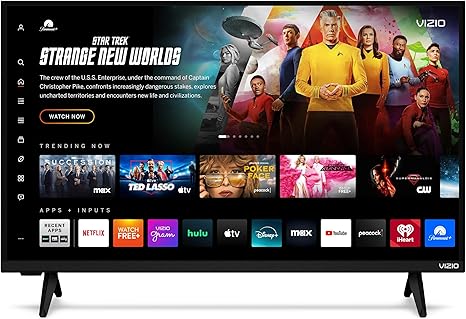
Smart‑TV‑wise, it runs VIZIO OS (sometimes called SmartCast), which gives you built-in access to popular streaming apps. You’ll also have the WatchFree+ section — VIZIO’s free‑to-watch channels and On Demand library, which is quite handy for no‑subscription viewing. For casting, the TV supports both Apple AirPlay 2 and Google Cast, so you can beam content from your phone or laptop easily. Connectivity-wise, it has two HDMI ports, a USB input, optical audio out, and built‑in Wi‑Fi (dual-band Wi-Fi 5). For audio, it’s packing DTS Virtual:X, so VIZIO is trying to give a surround-like depth from its built-in speakers. Importantly, it supports Bluetooth headphones, letting you listen privately — a nice touch for a small TV in a shared space. There’s also smart‑assistant compatibility: you can control it with Alexa, Google Assistant, or Apple Home (though the TV itself doesn’t have a built-in mic — you’ll use your external assistant device).
In terms of design, it’s quite minimal and modern: a three-sided thin bezel (VIZIO calls it “ThinFrame”), which helps it look more contemporary. The dimensions are modest (about 28.3 inches wide without the stand) and it supports VESA 100 × 100 for wall mounting, so you’ve got flexibility for tight spaces like a bedroom or kitchen.
My Real‑World Experience
Setting this up was straightforward. The stand is simple to attach, though I found it a little finicky to get the legs perfectly balanced initially. Once it was up and running, connecting it to Wi‑Fi was quick, and registering a VIZIO Account (necessary for smart features) was painless.
I tested it in a couple of scenarios: streaming, casual gaming, and as a screen for my laptop. For streaming — I tried Netflix, YouTube, Disney+, and more via VIZIO OS. The performance felt snappy enough, though navigating menus wasn’t blazing-fast. WatchFree+ is genuinely useful; having a built-in library of free content is a plus, especially in a secondary TV setup. Picture quality on Full HD content — say, 1080p YouTube or Netflix shows — was crisp, and the full-array backlight gave a decent uniformity in brightness. In dark scenes, the contrast was decent, though you wouldn’t mistake it for a premium HDR TV.
For gaming, I hooked up a console. The TV detected the console input and switched into a low-latency mode (Auto Low Latency Mode) which made responsiveness feel acceptable for casual play. HDR10 did make some visuals pop more, but given the panel is only Full HD, the effect is somewhat limited compared to a 4K HDR set. Still, for a small room or for light gaming, it’s adequate.
On audio, the DTS Virtual:X system gives a reasonable “virtual” surround feel — dialogue is clear, but don’t expect booming bass. In fact, in my testing room (a small living room), I found the bass to be weak. If you care a lot about rich audio, you’d probably want a soundbar. That said, I paired some Bluetooth headphones and watched late at night with zero fuss — that feature really shines in quiet environments, or when you don’t want to disturb others.
Picture tuning is basic but usable. The Active Pixel Tuning does help, but manual adjustments were necessary for me to get brightness and color balanced in a well-lit room. The default settings felt a bit flat for some content, so a little calibration went a long way.
What’s Good, and What Isn’t So Good
On the plus side, this VIZIO checks a lot of boxes for a compact smart TV. The 1080p resolution on a 32″ screen is actually a sweet spot: everything looks sharp enough, and you don’t need 4K to make the most of this size. The full-array backlight is a strong addition at this price and size — it improves contrast and overall picture uniformity. The smart platform is robust, offering both paid and free content, and casting support via AirPlay and Google Cast is very convenient. The Bluetooth headphone support is a huge plus for private listening, and the inclusion of Auto Low Latency Mode shows VIZIO cares about gaming usability. The design is clean, and the VESA mount compatibility means it works well on walls.
However, there are trade‑offs. The 60 Hz refresh rate limits its appeal for high-speed gamers or those who want very smooth motion. The HDR10 is somewhat superficial — this isn’t a high‑brightness HDR display, so you won’t see dramatic HDR effects. Sound quality is serviceable but weak on bass; the internal speakers are not going to wow you compared to a dedicated audio setup. There’s also limited ports — only two HDMI inputs means you might need to juggle devices. The remote is IR based, which means you have to point it directly at the TV, and the interface isn’t as fast or fluid as some higher-end smart TV systems.
Longevity and build: the build quality feels lightweight but decent. The plastics don’t feel premium, but that’s to be expected for a budget 32″ set. While I haven’t owned it for years, VIZIO’s reliability record is mixed: some users report solid long-term usage, while others mention firmware bugs or issues with smart functions over time. On the support front, I didn’t have to reach out to customer service myself, but VIZIO’s reputation is somewhat polarised: some praise its affordability, others complain about slow or unhelpful service. It’s definitely not premium-tier after-sales support.
How Much Value Are You Getting?
Considering the price point — this model sells for significantly less than bigger or 4K TVs — the VFD32M‑08 offers compelling value, especially for secondary rooms. If you compare it to other 32” smart TVs, its full HD resolution, full‑array backlight, and smart features including WatchFree+ make it stand out. For example, cheaper 32″ TVs might only do 720p; more expensive ones might add 4K but also bulk up the cost significantly.
If you were to spend a little more, you could step up to a 43″ smart TV with 4K, but then you’re changing the size category and perhaps increasing cost, so this VIZIO sits right in the balance for its class. If you don’t need ultra‑fast gaming or high‑end audio, this is a very practical, affordable pick.
How It Compares to Alternatives
Compared to other small smart TVs, like certain 32″ models from Samsung or LG, this VIZIO is competitive. Samsung’s 32″ smart LED sets might have slightly better UI speed or slightly different app ecosystems, but often they sacrifice either resolution or backlighting. LG’s small TVs might also be 720p. On the other hand, there are budget 4K models from off‑brands — but they typically come with weaker upscaling and less reliable smart platforms. The VIZIO strikes a good compromise: solid resolution, decent smart features, and enough inputs for everyday usage.
Final Thoughts
If you’re looking for a compact smart TV that doesn’t feel cheap and actually delivers on picture clarity, the VIZIO 32-inch Full HD (VFD32M‑08) is a very worthy candidate. It’s especially great for bedrooms, kitchens, offices, or gaming corners — anywhere a big TV isn’t necessary, but you still want good quality and smart features. The weak bass and limited ports are its main compromises, and it’s not for someone chasing cinematic HDR or ultra-smooth high-frame-rate gaming. But for its intended use case, it’s well designed and very usable. I’d recommend it to someone who wants a dependable, affordable smart TV in a smaller size.
Thanks for sticking around. Drop a comment if you’ve used this TV before — what worked for you, what didn’t — I’d love to hear your thoughts. Catch you next time on Reviews Inside TV — until then, stay tuned and stay smart.
Available to buy here:


