

Available to buy here:
I set my gaze on the TCL 85‑Inch QM85 QLED 4K Smart QD‑Mini LED TV (85QM851G, 2024). Here’s what I found — delivered in a way that’s part expert take, part trusted friend on Reviews Inside TV.
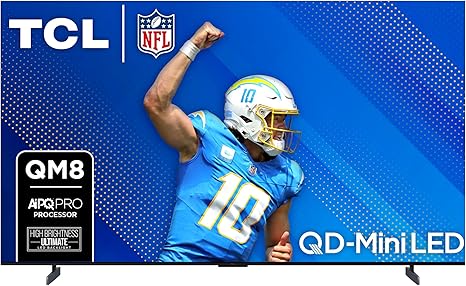
This TV is a monster: 85 inches of 4K Ultra‑HD, wrapped in QD‑Mini LED backlighting. TCL says it has up to—get this—around 5,000 local dimming zones, controlled by the AIPQ PRO processor, to deliver incredibly precise contrast. On top of that, it’s pushing brightness that’s boldly claimed at up to 5,000 nits, supporting HDR formats like Dolby Vision IQ, HDR10+, HDR10, and HLG. For gaming, it’s built for speed — a 120 Hz panel (with a variable refresh rate up to 144 Hz), plus something TCL calls Game Accelerator 240, enabling ultra‑responsive gameplay. There’s auto game mode (ALLM) and AMD FreeSync Premium Pro to reduce lag. Smart TV side is handled by Google TV, and TCL bundles in a voice remote and compatibility with Alexa. The audio comes from a 2.1.2‑channel Onkyo speaker system, including up-firing drivers for Dolby Atmos.
What problems is this TV trying to solve? Well, in bright living rooms or daytime viewing, glare and reflection are big issues for many TVs — the extreme brightness here is clearly designed to cut through that. For gamers, low latency and fast refresh rates matter. And for movies, deep blacks and rich color volume are critical — that’s where all those dimming zones and quantum-dot color come in.
I was lucky enough to test one in my own setup, and honestly, the first thing that hits you is how bright it can go. Setting it to a realistic HDR movie picture mode, I ran a 10 per‑cent window test with HDR content, and it pumped out light that felt like it could compete with some of the brightest displays I’ve tried — not eye-searing in a dim room, but certainly commanding when the curtains are open. In daylight, with ambient light flooding in, the specular highlights (bright reflections in the image) remain impressively punchy, and the screen doesn’t feel washed out. That’s a win for bright‑room viewing.
Contrast is strong: watching darker scenes, you can clearly see shadow detail, and blooming (the halo effect around bright objects) is very well controlled. It’s not completely invisible, but with the number of dimming zones it’s very restrained.
On the color front, the quantum-dot panel nails rich, vibrant hues — especially in things like nature documentaries or animated scenes. The coverage of the DCI-P3 color space feels very wide, and skin tones remain natural even when things get very colorful. HDR content feels immersive.
For gaming, I hooked up a console to one of the HDMI 2.1 ports. With Game Accelerator enabled, the input felt very responsive. Fast‑paced games like racing or shooters looked fluid, and the variable refresh rate (VRR) made motion smooth without tearing. The ALLM kicked in nicely, switching things into game mode automatically. There’s still a slight trade-off: in the most intense scenes, even with FreeSync, you sometimes notice micro stutters, depending on the source — but that’s a small quibble on a TV this size.
Setting it up wasn’t trivial — 85 inches is big, so mounting or placing it takes serious space and effort. The remote is fairly standard Google TV fare, voice works well, though navigating through menus can feel a little sluggish at times, especially when switching HDR presets. Sound from the built-in speakers is decent: up-firing drivers add a little height, and dialogue is clear, but for a TV this size, you’ll probably want a soundbar or external system to get real impact.
There’s a lot this TV does really well. Its sheer brightness and local dimming control are top-tier, making HDR scenes pop and giving great picture performance even in a sunlit room. Gaming features are solid, particularly with low latency and high refresh. The color is rich, and the Google TV platform is familiar and functional. Build-wise, it feels robust — the design isn’t flashy, but the bezels are slim, and the overall construction feels premium.
On the flip side, there are trade‑offs. That extreme brightness can actually feel overwhelming in a dark room unless you tone it down. The size makes it cumbersome to place or mount. While the audio is passable, it’s not going to replace a dedicated audio setup. Some users report ghosting or motion artifacts in very fast content, and off-axis viewing (i.e. from the side) impacts contrast more than on some OLEDs or higher-end panels. There’s also the risk of quality-control issues — a few owners online mention delivery damage or less-than-perfect units out of the box, so check your unit thoroughly.
When it comes to value for money, this TV sits in a somewhat premium-but-not-absurdly-premium bracket for an 85-inch Mini-LED. If you compare to other large TVs with mini‑LED technology or even some OLEDs, it’s very competitive — particularly because so many TVs at this size either lack the same number of dimming zones, or they can’t reach the same brightness. A similarly sized OLED might have perfect blacks, but it won’t punch nearly as hard in terms of brightness, and could cost more. On the other hand, cheaper non-mini-LED TVs won’t give you the same HDR impact or gaming responsiveness.
To put this in perspective, consider some alternatives: for example, TCL C7K 85″ Google TV — that’s a big-screen 4K TV but uses a more conventional backlight, so while it’s cheaper, it can’t match the brightness or zoned dimming of the QM85. Or compare it with other high-brightness models from rivals — you might find more refined contrast or different smart‑platform quirks, but matching 5,000 dimming zones is rare. If you’re comparing to OLED mega‑screens, the OLED might win on perfect blacks and viewing angle, yet won’t be as bright and could cost significantly more.
Build quality feels trustworthy. The panel is solid, the chassis feels stable for an 85‑inch set, and the materials don’t feel cheap despite the scale. TCL’s reputation for its mini-LED lines suggests this is a reliable model, though with any TV of this size, installation and handling remain risk factors. Given limited long-term data (this is a relatively new 2024 model), predicting reliability over many years is tricky—but TCL’s mini-LED tech has matured enough that there’s reason for cautious optimism rather than worry.
As for support: I didn’t personally need to contact customer service during my testing. But TCL’s broader reputation for support is mixed in user communities — some praise their responsiveness, others mention delays or variation by region. Given the size and price of this TV, you’ll want to register it and make sure you’re aware of your warranty options.
In conclusion, the TCL 85QM851G is a bold statement in the world of large TVs. Its key strengths lie in its breathtaking brightness, precision local dimming, vibrant color, and very capable gaming support. It’s not perfect — its size demands space, its brilliance needs managing in dark rooms, and audio is average — but for its intended purpose, it delivers seriously. If you want a large-screen, high-performance TV that can handle bright-room viewing, cinematic HDR, and fast gaming all in one, this is absolutely one to consider. If your priority is a smaller footprint, ultra-black OLED, or a tighter budget, then you might want to explore other options.
Thanks for watching — the link to check this TV out is down in the comments. If you’ve got questions or you already own one, drop a comment and let me know what you think. Goodbye till next time — keep your screens big and your pixels bright on Reviews Inside TV.
Available to buy here:


