

Available to buy here:
Welcome to “Reviews inside tv,” where we break down the latest products with an expert touch. Today, we’re taking a close look at the Crucial T700 2TB Gen5 NVMe M.2 SSD with Heatsink—a storage solution designed to meet the demands of gamers, photographers, video editors, and creatives. With claims of blazing fast speeds and cutting-edge features, does it live up to the hype? Let’s find out.
The Crucial T700 2TB SSD is part of the latest generation of solid-state drives, offering a peak sequential read speed of up to 12,400MB/s and sequential write speeds up to 11,800MB/s. These figures are truly impressive, especially for an NVMe M.2 drive. Whether you’re storing your game library, working with 8K video files, or handling large photography projects, the T700 promises to make every task feel smoother and faster. But it’s not just about raw speed; the drive also offers random read and write speeds of up to 1.5 million IOPS, which translates to faster data access across a wide range of operations.
One of the key selling points of this SSD is its support for Microsoft’s DirectStorage technology. This feature is especially tailored for gamers, promising up to 60% faster texture rendering and significantly reduced load times. For creatives, this translates into quicker photo edits, smoother video rendering, and the ability to work with larger files without the system bogging down. And for those working with heavy workloads or multiple apps at once, the T700 claims to reduce CPU utilization by up to 99%, freeing up resources for other tasks.
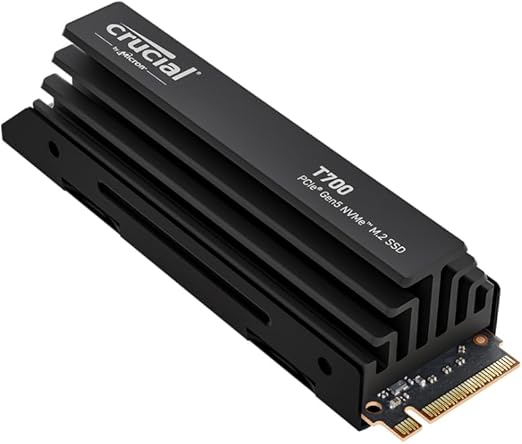
The T700 is equipped with a premium aluminum and nickel-plated copper heatsink, which helps manage heat dissipation effectively without the need for noisy fans or liquid cooling. This means you can expect better cooling performance while maintaining a quiet and efficient system, which is particularly important for gaming setups and high-performance workstations where heat can be a concern. There’s also a non-heatsink version available for those who have adequate airflow in their system, but the version with the heatsink is a nice bonus for those looking for maximum thermal efficiency.
When it comes to storage capacity, this drive doesn’t skimp. With a 2TB option and up to 4TB available, you’ve got plenty of space for everything from large game libraries to high-resolution media files. The drive utilizes Micron’s 232-layer TLC NAND, a technology designed to deliver excellent durability and performance, particularly in systems using Intel’s 13th Gen and AMD Ryzen 7000 series CPUs. That’s a solid pairing, ensuring you get the most out of your hardware while future-proofing your setup for years to come.
In real-world use, the Crucial T700 has proven itself as a reliable and high-performance SSD. For gaming, load times were noticeably quicker than with traditional SSDs, with games like “Cyberpunk 2077” seeing faster texture loads and smoother transitions. For video editing, this SSD made short work of 4K video files, with rendering times noticeably reduced. And when dealing with massive Photoshop projects, the T700 kept everything running smoothly without any signs of lag or delay.
However, it’s not perfect. While the performance is top-tier, it’s also worth noting that, at the time of testing, the price point is on the higher end, especially compared to other SSDs in the market. If you’re on a budget, you might find similar performance from more affordable options, though you might miss out on some of the premium features like DirectStorage support and the advanced heatsink.
The build quality of the T700 is undeniably solid. The heatsink feels durable and robust, and it’s clear that Crucial has put thought into ensuring the drive remains as cool as possible during heavy usage. Given that this is a premium SSD, you’d expect nothing less. While long-term durability remains to be fully proven—since this is still a relatively new release—the track record of Crucial and Micron’s NAND technology inspires confidence that it will hold up well over time.
Customer support, although not something that we had to engage with during our testing, is worth mentioning. Crucial, as a well-established brand in the SSD space, has a solid reputation for customer service, with fast response times and helpful support. For anyone who needs assistance, they’re generally responsive and provide clear instructions for troubleshooting.
When compared to similar products on the market, the Crucial T700 stands out with its combination of high-speed performance, DirectStorage compatibility, and a built-in heatsink. Alternatives like the Samsung 980 Pro or the WD Black SN850X offer competitive speeds but may lack some of the unique features of the T700, such as the heat management system and DirectStorage. That being said, these alternatives are often priced slightly lower, so if budget is a key factor, those may still be worth considering.
In terms of value for money, the Crucial T700 is certainly a premium offering, but it justifies its price with performance. If you’re a gamer or a creative professional who needs the absolute best in storage speed and performance, it’s hard to beat. However, if you’re looking for a more affordable solution and can compromise slightly on some features, there are other SSDs that offer close performance at a better price.
To sum up, the Crucial T700 2TB Gen5 NVMe M.2 SSD with Heatsink is an outstanding choice for those who demand top-tier performance in gaming, video editing, and design. It offers blazing fast speeds, a solid heatsink for heat management, and DirectStorage support, all packed into a sleek and durable design. While it’s a bit pricey, it’s hard to argue with the results it delivers. If you’re looking for the best in class, this is definitely one to consider.
Thanks for watching, and if you’re thinking about picking up the Crucial T700, the link to grab it is down in the comments box. Got questions or thoughts on the T700? Drop them below—we love hearing from you! Until next time, stay tuned to “Reviews inside tv” for more in-depth product breakdowns.
Available to buy here:


