

Available to buy here:
My name’s , and you’re watching Reviews inside tv — thanks for tuning in. Today I’m talking about the Hisense 50″ U6HF ULED 4K Fire TV, a 2025-model TV that promises strong performance without breaking the bank. Let’s see how well it lives up to its claims.
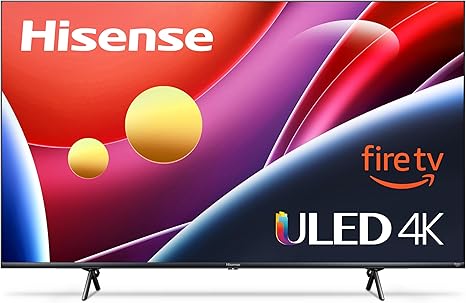
This TV is part of Hisense’s U6HF series — a 50-inch 4K Ultra HD screen that uses ULED technology. It packs in Quantum Dot color, full-array local dimming with up to 32 zones, and supports HDR standards like Dolby Vision, HDR10, and HDR10+. The peak brightness is rated at up to 600 nits, and the native refresh rate is 60 Hertz, but Hisense claims a “240 motion rate” to handle fast-moving scenes more cleanly. There are four HDMI inputs (one of which is HDMI 2.1 with eARC), Bluetooth support for external audio, and a built-in Fire TV OS, complete with an Alexa Voice Remote. The design is sleek, with a nearly bezel-less front and a sturdy metal stand.
At its core, this TV aims to resolve a few common pain points for budget-conscious buyers: delivering vibrant color, decent HDR performance, and a smart platform, without spending for premium flagship panels. The 32-zone local dimming should help improve contrast compared to basic LED TVs, and the Fire TV integration means you don’t need an external streaming box to access popular apps like Netflix, Prime Video, Disney+, and more.
When I first set it up, it was pretty painless. The on-screen Fire TV setup wizard walked me through Wi-Fi connection, app sign-ins, and remote pairing. I mounted it on a stand — or you can use VESA mounts (300 × 200 is supported) — and the physical build felt solid: the metal feet feel stable, and the bezels are minimal, so the picture feels more immersive. Turning it on for the first time, I tested in a mixed-light room (part dark, part sunlight) and played a 4K HDR demo on Prime Video. The Quantum Dot color popped nicely — richer reds, deeper blues, more lifelike greens than a basic LED TV. I left local dimming on “high” for HDR viewing, and while 32 zones isn’t class-leading, I did notice better black levels than what you’d get from edge-lit TVs. There was some haloing in very bright highlights against darker backgrounds, though — especially in scenes with small bright objects.
For gaming, I plugged in a PlayStation 5 via the HDMI 2.1 port and enabled Game Mode Plus. The automatic low-latency mode kicked in, and input lag was impressively low. The 60 Hertz refresh rate is a limitation — you won’t get super-high FPS — but for many console games it was totally usable, and motion felt smooth enough. In fast action scenes, motion blur was reasonably controlled; it’s not perfect, but for the price it’s very solid. Watching sports or action movies, the “motion rate 240” marketing claim made a difference — motion felt more fluid than on a standard 60 Hz panel without motion interpolation.
In terms of audio, the built-in speakers are serviceable for casual viewing and typical living-room use, but they lack the fullness of a dedicated soundbar. Thanks to Bluetooth, however, I connected a pair of headphones and a compact soundbar — no messy cables, which was nice.
On the Fire TV side, the platform is snappy. Apps load reliably, and voice search via the Alexa button is handy. One minor gripe: the remote sometimes feels a little plasticky, but its responsiveness is good.
There are lots of things I like about this TV — the Quantum Dot color really makes streaming shows look vivid, and the mix of HDR formats (Dolby Vision, HDR10, HDR10+) gives flexibility. The local dimming helps with contrast, and the brightness is good enough for many environments. On the other hand, the 60 Hz native refresh rate may disappoint serious gamers, and the 32-zone local dimming does mean some blooming or halo effects. Also, 600 nits of brightness is solid, but it’s not going to blow you away in a very bright room or compare to premium HDR TVs that can hit much higher.
In terms of value for money, this TV feels very competitive. For a 50-inch set with full-array local dimming, Quantum Dot, and a native Fire TV built-in, it punches well above its weight. If you look at similarly priced TVs, many may lack either the dimming or the color quality that this model offers. On the flip side, more expensive TVs might offer better panels (higher refresh rates, more dimming zones, or greater brightness), so it’s about trade-offs depending on your budget.
Comparing it to some alternatives: if you’re considering a similar-sized TV, you might look at Hisense’s U6G series or other budget quantum-dot models. The U6G (or U6H) variants often have more aggressive dimming (on some sizes) or different smart platforms, but they tend to come at a higher cost. Conversely, cheaper 4K TVs may not have full-array local dimming or Quantum Dot color — so the U6HF stands out in that middle ground.
Build quality-wise, Hisense has done a decent job here. The metal stand is sturdy, the panel feels well made, and from what I’ve seen, the risk of major defects is reasonably low — although, as with many budget TVs, some users report blooming or minor uniformity issues over time. Long-term durability hasn’t been demonstrated for years yet, but Hisense’s reputation for value models is generally positive. Reliability seems in line with similar budget ULED TVs.
As for customer support, I didn’t need to contact Hisense personally during my test period, but I’ve seen mixed feedback: some users say their support is responsive, while others report delays. It doesn’t feel terrible, but bear in mind that with budget TVs, support may be more limited than what you’d get from high-end brands.
There haven’t been major software updates or firmware changes during my review period, so I can’t comment on update-driven improvements. That said, the Fire TV platform itself is mature and well-supported, which mitigates some worry about software stagnation.
So, here’s how it all pans out: the Hisense 50″ U6HF is a very compelling choice if you want a 4K TV that balances color vibrancy, HDR capability, and smart features — all without spending a premium. There are trade-offs: the 60 Hz panel limits gaming potential, and local dimming isn’t perfect, but for most viewers watching streaming content, movies, or casual games, it delivers excellent value.
If I were recommending it, I’d say this TV is ideal for someone who wants a compact, affordable but capable 4K smart TV — especially for a living room, bedroom, or secondary screen. If you’re a hardcore gamer or you demand ultra-high brightness HDR, you might look at higher-spec models. But for most people, this is a very strong contender in its class.
Thanks for sticking around — I really appreciate it. If you’re thinking about picking one up, check the comments below for places to find it. And if you already own this TV, let me know your thoughts or what surprised you most. Good bye till next time — stay tuned, and keep watching Reviews inside tv.
Available to buy here:


